
- 1. Introduction
- 2. Quick Facts About the Great Wall of China
- 3. Where Is the Great Wall of China Located?
- 4. History of the Great Wall of China
- 5. Why Was the Great Wall of China Built?
- 6. Construction Secrets of the Great Wall
- 7. Mind-Blowing Engineering Facts
- 8. Hidden Secrets and Lesser-Known Facts
- 9. Architectural Features of the Great Wall
- 10. Important Sections of the Great Wall to Visit
- 11. Cultural and Historical Importance
- 12. UNESCO World Heritage Status
- 13. Modern-Day Tourism and Travel Guide
- 14. Conservation and Preservation Challenges
- 15. Interesting Myths and Legends
- 16. Great Wall of China in Modern Culture
- 17. Why the Great Wall of China Is Still Relevant Today
- Frequently Asked Questions (FAQ)
1. Introduction
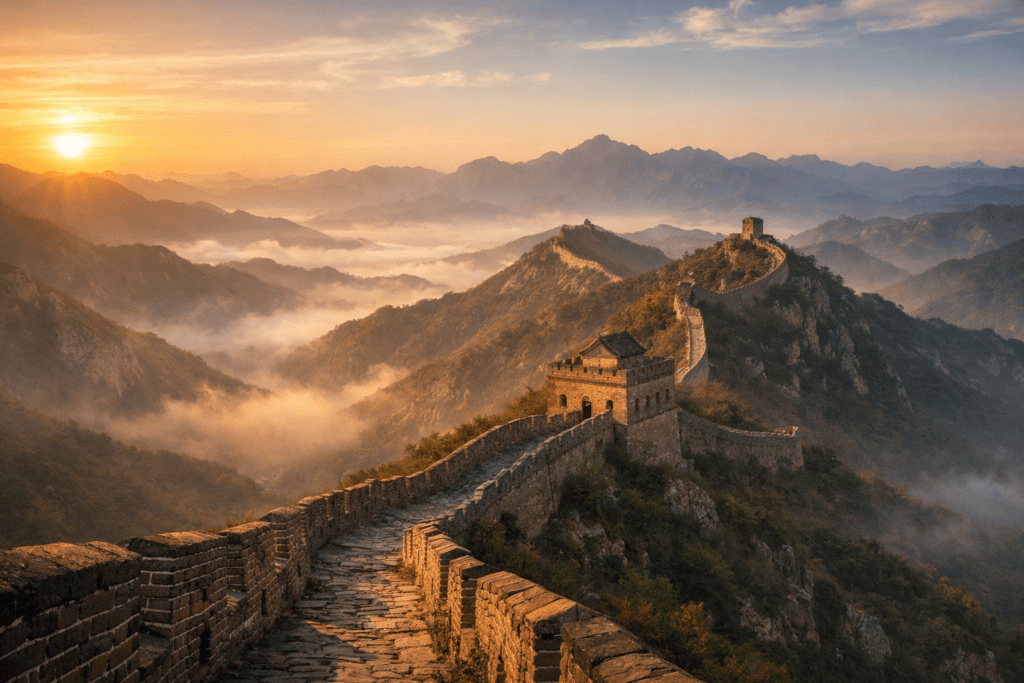
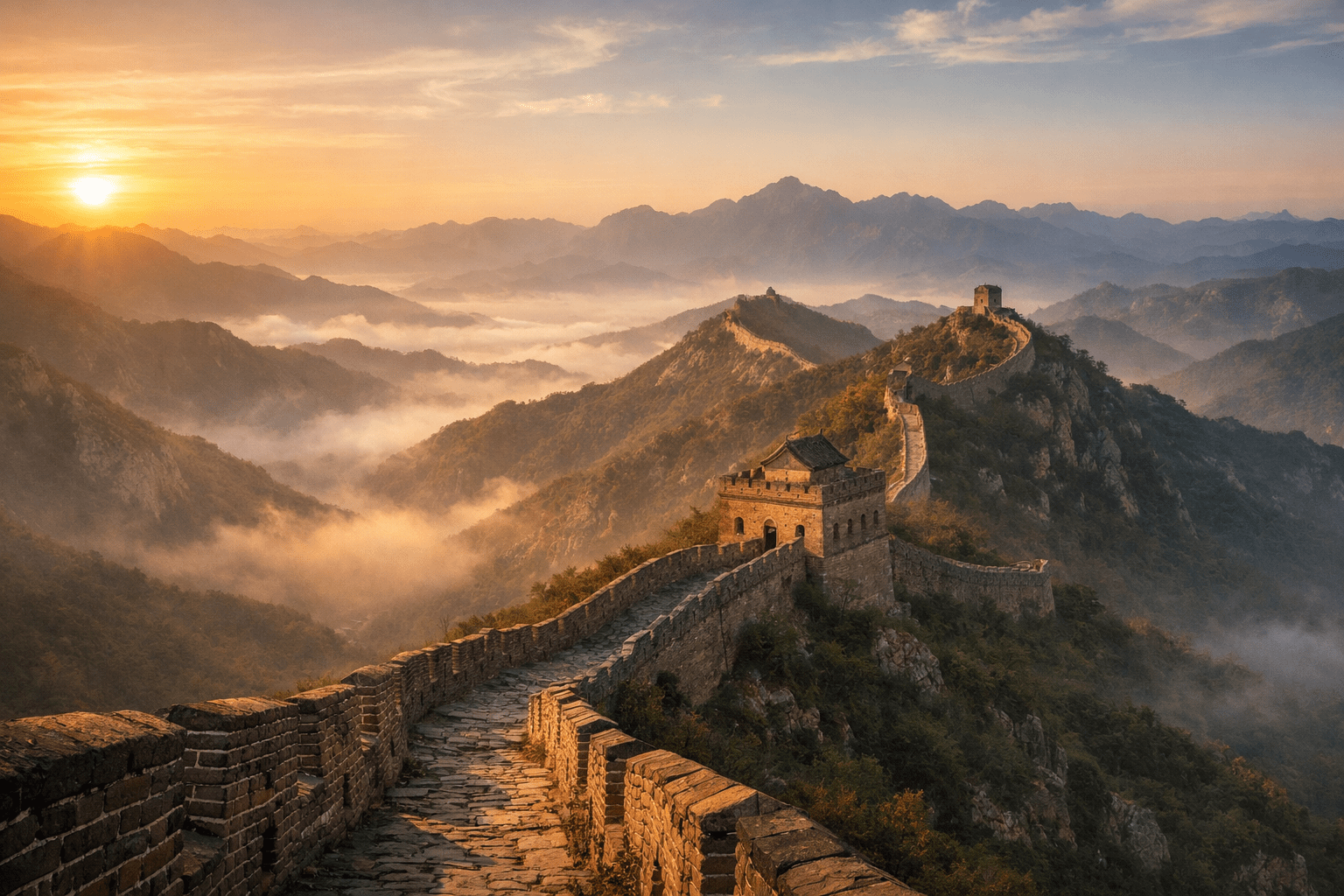
The Great Wall of China is one of the most famous structures ever built by humans. Stretching across mountains, deserts, and grasslands, this enormous wall has stood for centuries as a symbol of China’s strength, determination, and history. Many people have heard about it, but very few truly understand how massive, complex, and fascinating it really is.
The wall was not built all at once. Instead, it was constructed over many centuries by different Chinese dynasties. Each dynasty added its own sections, repaired old parts, and strengthened the wall depending on their needs. Because of this, the Great Wall is not just one wall. It is actually a network of walls, watchtowers, fortresses, and passes that together form one of the greatest defensive systems in history.
Today, the Great Wall is recognized as a UNESCO World Heritage Site. It attracts millions of visitors every year and is considered one of the greatest architectural achievements ever created. However, beyond its beauty and popularity, the wall hides many secrets, struggles, and incredible stories of human effort.
In this article, you will learn about the real history of the Great Wall, why it was built, how workers constructed it without modern machines, and many surprising facts that most people do not know.
2. Quick Facts About the Great Wall of China
Before we go deeper into the history and secrets, let us quickly look at some important facts about the Great Wall.
Key Information
Location: Northern China
Total Length: Approximately 21,196 kilometers (13,171 miles)
Construction Period: Around 7th century BCE to 17th century CE
Dynasties Involved: Qin, Han, Ming, and several earlier regional states
Purpose: Defense against invasions, trade protection, and border control
UNESCO Status: Listed as a World Heritage Site in 1987
Main Materials Used: Stone, brick, rammed earth, wood, and lime mortar
Watchtowers and Fortresses: Thousands built along the wall for military communication and defense
One interesting fact is that if all sections built by different dynasties are combined, the wall becomes far longer than most people imagine. Many parts have been destroyed over time, but several sections still stand strong today.
3. Where Is the Great Wall of China Located?
The Great Wall stretches across northern China and passes through several provinces. These include Hebei, Beijing, Tianjin, Shanxi, Inner Mongolia, Ningxia, and Gansu. The wall covers a huge area and crosses different types of landscapes.
In some places, the wall climbs steep mountain ridges. In other areas, it crosses deserts and open grasslands. Builders used the natural terrain to strengthen the wall’s defensive power. For example, mountains made it harder for enemies to attack, while deserts acted as natural barriers.
The location of the wall was carefully chosen for military reasons. Northern China faced repeated invasions from nomadic tribes living in the Mongolian steppes. These tribes were skilled horse riders and could attack quickly. The wall helped slow down these attacks and gave Chinese armies time to prepare.
The wall also protected important trade routes, especially those connected to the famous Silk Road. Traders carrying silk, spices, and other valuable goods passed through guarded gates along the wall.
4. History of the Great Wall of China
The story of the Great Wall is long and complex. It was built over more than two thousand years, and different dynasties played important roles in shaping it.
4.1 Early Walls Before Imperial China
The idea of building defensive walls started long before China became a unified empire. During the Warring States Period (around 475–221 BCE), China was divided into several smaller kingdoms. These kingdoms often fought each other for land and power.
To protect themselves, many kingdoms built walls along their borders. These early walls were usually made from packed earth and wood. They were not as strong or long as the later Great Wall, but they showed the early development of defensive construction.
These regional walls became the foundation for what would later become the Great Wall of China.
4.2 Qin Dynasty Construction (221–206 BCE)
The real beginning of the Great Wall happened when Emperor Qin Shi Huang unified China in 221 BCE. He became the first emperor of a united China and wanted to protect his empire from northern invasions.
Instead of building a completely new wall, Qin Shi Huang ordered workers to connect and strengthen the existing walls built by earlier kingdoms. This was a massive project that required huge amounts of labor.
The emperor used soldiers, farmers, prisoners, and forced laborers to build the wall. Construction was extremely difficult because workers had to carry heavy materials across mountains and rough landscapes. Many workers suffered from hunger, exhaustion, and harsh weather conditions.
Historians believe that thousands, possibly hundreds of thousands, of workers died during this period. Because of this, the wall is sometimes called the longest cemetery in the world.
Despite the human cost, Qin Shi Huang successfully created a strong defensive barrier that protected northern China.
4.3 Han Dynasty Expansion
After the Qin Dynasty collapsed, the Han Dynasty took control of China. The Han rulers expanded the Great Wall further toward the west. Their main goal was to protect the Silk Road, which was becoming an important trade route connecting China to Central Asia and Europe.
The Silk Road brought wealth, culture, and foreign influence into China. However, it also attracted attacks from nomadic tribes and bandits. The Han Dynasty built additional walls, watchtowers, and military posts to protect traders and control border movements.
During this time, the wall was not only a defensive structure but also a tool for economic security. Soldiers stationed along the wall guarded caravans and monitored trade activities.
4.4 Ming Dynasty Reconstruction (1368–1644)
The Ming Dynasty built the sections of the Great Wall that most visitors see today. After overthrowing the Mongol-led Yuan Dynasty, the Ming rulers wanted to prevent further Mongol invasions.
The Ming government rebuilt and strengthened large portions of the wall using bricks and stone instead of rammed earth. These materials made the wall stronger and more durable.
They also built thousands of watchtowers, signal towers, and fortified passes. These structures allowed soldiers to communicate quickly using smoke signals during the day and fire signals at night.
The Ming version of the wall was a highly advanced military defense system. It was carefully designed to control movement, defend against attacks, and support soldiers stationed along the border.
5. Why Was the Great Wall of China Built?
Many people think the Great Wall was built only to stop enemies, but its purpose was actually much broader.
The main reason was protection from northern invaders. Nomadic tribes from the north, such as the Xiongnu and later the Mongols, were skilled warriors and horse riders. They could attack quickly and disappear just as fast. The wall slowed them down and reduced surprise attacks.
The wall also worked as a border control system. Gates and passes allowed the government to monitor who was entering and leaving the empire. This helped control migration and maintain security.
Another important purpose was trade protection. The wall guarded important trade routes, especially parts of the Silk Road. Soldiers stationed along the wall protected merchants from bandits and ensured safe passage for goods.
The Great Wall also acted as a communication system. Using watchtowers and signal fires, messages could be sent across long distances in a short time. This allowed armies to prepare for attacks quickly.
Over time, the wall became a symbol of national strength. It showed the power of the Chinese state and its ability to organize massive construction projects.
6. Construction Secrets of the Great Wall
Building something as large as the Great Wall without modern machines may seem impossible today. However, ancient builders used intelligence, teamwork, and local resources to achieve it.
6.1 How the Great Wall Was Built Without Modern Technology
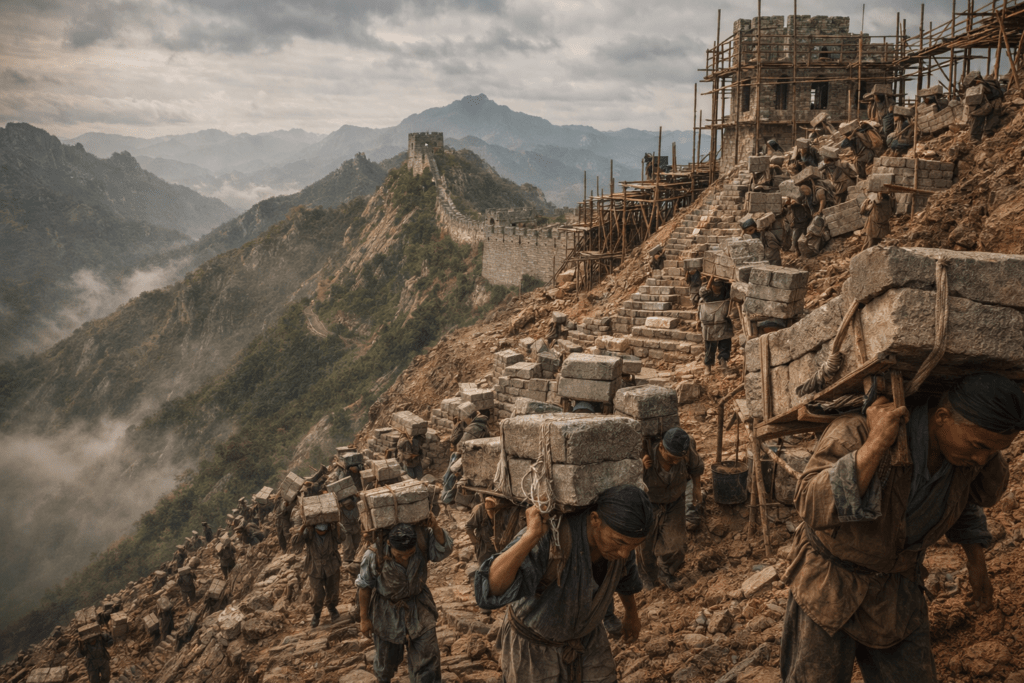
Workers relied entirely on manual labor. They used simple tools like wooden carts, ropes, chisels, and baskets. In mountain areas, stones were carried by hand or rolled into place.
One clever method was using the natural terrain. Instead of flattening mountains, builders followed ridges and cliffs. This saved effort and made the wall stronger against attacks.
Construction was slow, exhausting, and dangerous. In many areas, workers lived on-site for months or even years.
6.2 Materials Used in Construction
The materials depended on the local environment.
- Stone was used in mountainous areas
- Bricks were common during the Ming Dynasty
- Rammed earth (packed soil) was used in deserts and plains
- Wood was used for temporary structures and support
- Lime mortar, sometimes mixed with sticky rice, helped bind bricks and stones together
This use of local materials reduced transportation problems and made construction more efficient.
6.3 Role of Workers and Labor Force
The workforce was made up of:
- Soldiers
- Farmers
- Prisoners
- Forced laborers
Estimates suggest hundreds of thousands to over a million people worked on the wall over centuries.
Life for workers was extremely hard. Food was limited, injuries were common, and medical care was almost nonexistent. Many workers died from exhaustion, disease, or accidents. Their suffering is an important part of the wall’s history.
6.4 How Builders Transported Materials Across Mountains
Transporting materials was one of the hardest tasks.
Builders used:
- Animals such as donkeys and oxen
- Human chains passing stones hand to hand
- Locally sourced stone and soil to reduce travel distance
In some areas, materials were carried up steep slopes using ropes and wooden sleds. This required great coordination and strength.
7. Mind-Blowing Engineering Facts
The Great Wall was more than just a wall. It was a smart military system.
Watchtowers were placed at regular intervals. Soldiers used smoke signals during the day and fire signals at night to warn of enemy attacks. Different numbers of smoke columns could send different messages.
The wall included drainage systems to prevent rainwater damage. Sloped surfaces helped water flow away instead of weakening the structure.
Some sections were designed with enemy traps, such as narrow passages and steep stairways, making it difficult for attackers to move quickly.
8. Hidden Secrets and Lesser-Known Facts
One common myth is that the Great Wall can be seen from space with the naked eye. This is not true. It is usually not visible without aid.
Some parts of the wall include hidden tunnels and secret routes used by soldiers. Many of these remain unexplored.
There are legends that dead workers were buried inside the wall. While human suffering was real, historians believe most bodies were buried nearby, not inside the structure.
Large sections of the wall remain abandoned and forgotten, slowly eroding into the landscape.
9. Architectural Features of the Great Wall
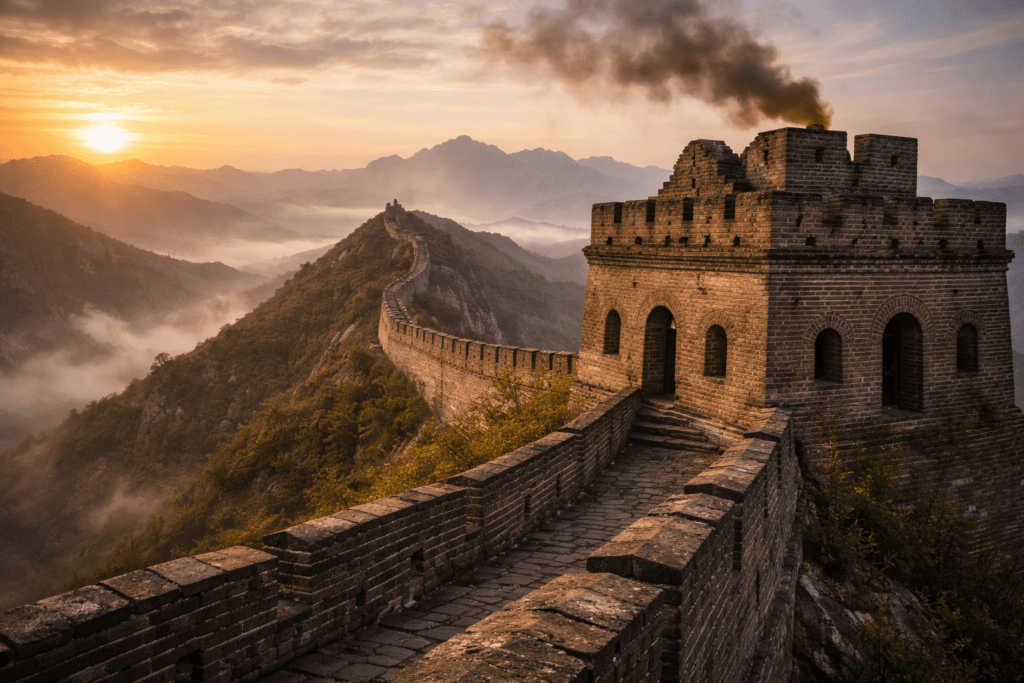
The Great Wall includes many important structures:
- Watchtowers for observation and communication
- Beacon towers for long-distance signaling
- Fortresses and passes controlling key routes
- Gates and checkpoints for trade and military movement
The wall’s height, width, and design changed depending on location and period. Some sections were wide enough for horses and carts.
10. Important Sections of the Great Wall to Visit
10.1 Badaling Section
This is the most famous and most visited section. It is well restored and easy to access from Beijing. Facilities like cable cars and walkways make it suitable for first-time visitors.
10.2 Mutianyu Section
Mutianyu is less crowded and more scenic. It is surrounded by forests and hills and is popular with families. The wall here is well preserved.
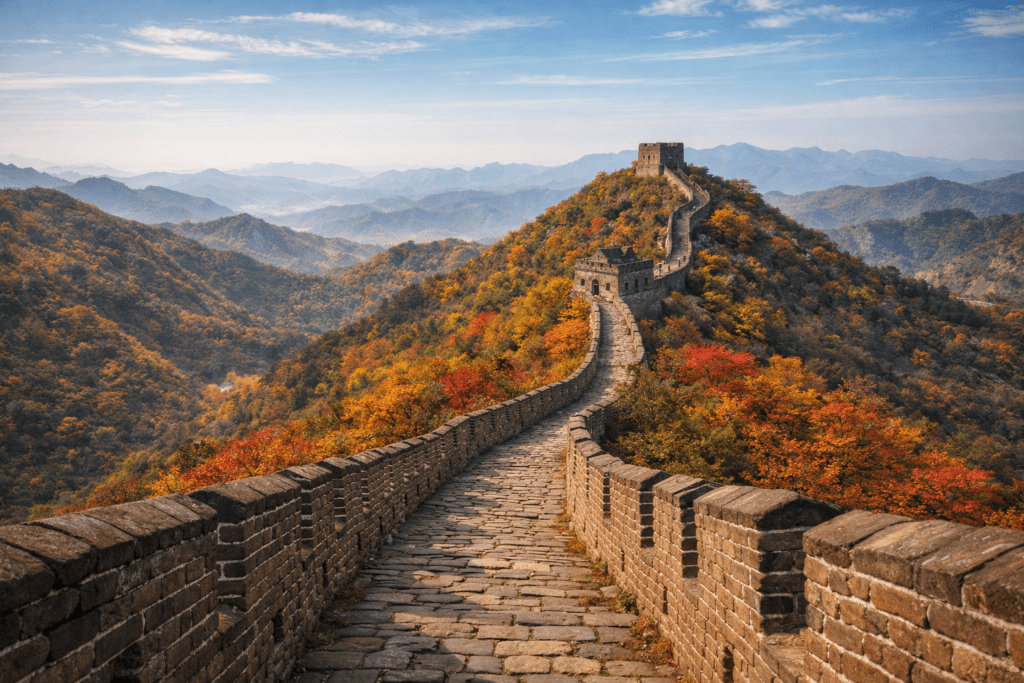
10.3 Jinshanling Section
This section is ideal for hikers and photographers. It includes both restored and original sections, offering a more authentic experience.
10.4 Simatai Section
Simatai is known for its steep paths and night visits. It is more challenging and attracts adventurous travelers.
11. Cultural and Historical Importance
The Great Wall of China is not just a military structure. Over time, it became a powerful symbol of Chinese identity and cultural pride.
For many Chinese people, the wall represents determination and unity. It shows how people worked together over generations to protect their homeland. The wall is often mentioned in Chinese literature, poetry, and folklore. It appears in stories that describe bravery, sacrifice, and loyalty.
The Great Wall also played an important role in shaping China’s relationship with neighboring regions. It marked boundaries, controlled trade, and influenced cultural exchange between China and Central Asia.
Today, it is considered one of the most recognizable cultural landmarks in the world. It helps people understand China’s long and complex history.
12. UNESCO World Heritage Status
The Great Wall was declared a UNESCO World Heritage Site in 1987. This recognition highlights its importance as one of the greatest achievements of human civilization.
UNESCO recognized the wall because of:
- Its historical value
- Its architectural and engineering excellence
- Its cultural importance
- Its influence on world heritage
Since receiving UNESCO status, China has increased efforts to protect and restore the wall. Many damaged sections have been repaired, while others are preserved in their original condition for historical study.
The recognition also helped increase global awareness and tourism.
13. Modern-Day Tourism and Travel Guide
Today, the Great Wall attracts millions of visitors every year. Different sections offer different travel experiences.
13.1 Best Time to Visit the Great Wall
The best seasons to visit are spring (April to June) and autumn (September to November). During these months, the weather is comfortable and the scenery is beautiful.
Summer can be very hot and crowded. Winter offers fewer tourists and stunning snowy views, but the cold weather can make walking difficult.
13.2 How to Reach the Great Wall
Most visitors travel from Beijing because several famous sections are located nearby.
Travel options include:
- Public buses from Beijing
- Tourist shuttle services
- Guided tours
- Private taxi or car
Each option varies in cost, comfort, and travel time.
13.3 Entry Fees and Timings
Entry fees vary depending on the section and season. Popular sections like Badaling and Mutianyu usually charge higher ticket prices compared to less crowded areas.
Most sections open early in the morning and close in the late afternoon. Some places, such as Simatai, allow limited night visits.
Visitors should check official information before traveling, as timings may change.
13.4 Travel Tips for Visitors
Walking on the Great Wall can be physically demanding. Some sections include steep steps and uneven paths.
Helpful tips include:
- Wear comfortable walking shoes
- Carry water and snacks
- Check weather conditions before visiting
- Follow safety signs and avoid damaged sections
- Respect historical structures and avoid graffiti
- Carry a camera, as views from the wall are spectacular
14. Conservation and Preservation Challenges
Despite its strength, the Great Wall faces serious preservation challenges.
Natural erosion caused by wind, rain, and temperature changes slowly damages the wall. Desert areas are especially vulnerable to sandstorms.
Human activity is another major problem. Tourism, vandalism, and construction projects have damaged some sections.
The Chinese government has started restoration projects and introduced laws to protect the wall. Scientists and historians also study the wall to find better preservation methods.
However, protecting such a massive structure remains a difficult task.
15. Interesting Myths and Legends
Many legends surround the Great Wall. One famous story is about Meng Jiangnü, a woman whose husband died while working on the wall. According to legend, her grief caused part of the wall to collapse. This story reflects the suffering of workers and is still told in Chinese culture.
Another myth claims the wall can be seen from the Moon. Scientists have confirmed this is not true. The wall is too narrow to be visible from that distance.
These myths and stories show how deeply the wall is connected to cultural storytelling.
16. Great Wall of China in Modern Culture
The Great Wall appears in many films, books, and documentaries. It is often used as a symbol of China’s history and global heritage.
The wall is also one of the most photographed landmarks in the world. It plays a major role in tourism and helps introduce Chinese culture to international visitors.
Educational institutions often use the Great Wall as an example when teaching world history and ancient engineering.
17. Why the Great Wall of China Is Still Relevant Today
Even though it no longer serves as a military defense system, the Great Wall remains extremely important.
It represents:
- Cultural pride and national identity
- A major source of tourism income
- A valuable historical learning site
- A global example of ancient engineering excellence
The wall reminds people of human determination and the ability to create extraordinary structures with limited technology.
Frequently Asked Questions (FAQ)
Q1. How long is the Great Wall of China?
The Great Wall stretches approximately 21,196 kilometers (13,171 miles) when all sections built by different dynasties are combined.
Q2. Who built the Great Wall of China?
Different Chinese dynasties built the wall over many centuries. The Qin Dynasty started major construction, while the Ming Dynasty built most of the sections seen today.
Q3. Why was the Great Wall constructed?
The wall was built mainly to protect China from invasions, control borders, protect trade routes, and support military communication.
Q4. Can the Great Wall of China be seen from space?
No, it is a popular myth. The wall is generally not visible from space without special equipment.
Q5. How many years did it take to build the Great Wall?
Construction lasted for more than 2,000 years, starting from the 7th century BCE and continuing until the 17th century CE.
Q6. Which is the best section of the Great Wall to visit?
Badaling is best for first-time visitors. Mutianyu offers scenic views and fewer crowds. Jinshanling is popular for hiking, while Simatai is known for night visits and adventure.
Q7. How much does it cost to visit the Great Wall?
Ticket prices vary by location and season. Most sections charge between moderate entry fees, with additional charges for cable cars or special activities.
Q8. Is it safe to walk on the Great Wall?
Yes, restored sections are generally safe. However, visitors should follow safety guidelines and avoid damaged or closed areas.
Q9. How many workers died during construction?
Exact numbers are unknown, but historians believe many workers died due to harsh working conditions, injuries, and disease.
Q10. Is the Great Wall still being preserved today?
Yes. The Chinese government and heritage organizations continue restoration and preservation work to protect the wall for future generations.