
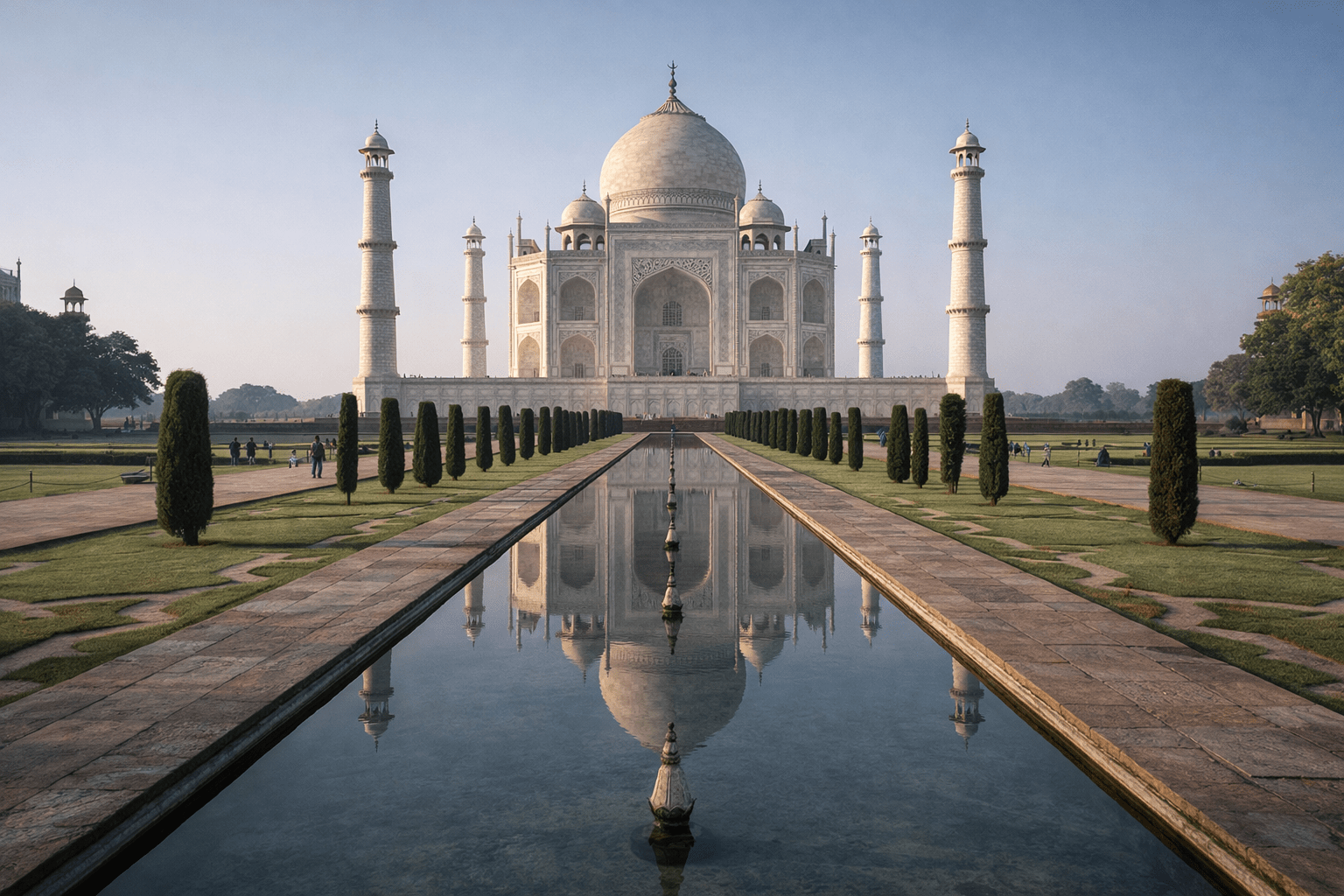
Introduction: More Than a Monument of Love
Even after more than 350 years, the Taj Mahal still has the power to stop people in their tracks.
You see it in the silence of first-time visitors.
You notice it when someone lowers their voice without being told.
You feel it when the white marble slowly changes color as the sun moves.
This reaction is not accidental.
The Taj Mahal is often described as the greatest symbol of love ever built. That description is not wrong. But it is incomplete. Love may have been the reason it was built, yet love alone cannot explain its scale, its precision, or its lasting emotional impact.
Most people arrive with a simple story in mind:
A heartbroken king built a beautiful tomb for his wife.
That story is true. But the deeper reality is far richer.
The Taj Mahal stands at the crossroads of human loss, imperial power, spiritual belief, artistic genius, and political ambition. It was created during the height of the Mughal Empire, when resources, talent, and authority could be brought together on an unimaginable scale. It reflects grief, yes—but also control, vision, and the desire to leave something eternal behind.
At its heart is a very human moment: the death of Mumtaz Mahal in 1631. She was not just a wife, but a constant companion of Emperor Shah Jahan. Her death changed him. What followed was not only mourning, but a decision—to turn personal loss into something that would outlive him, his empire, and even memory itself.
This is where many Taj Mahal facts begin to surprise people.
The monument was not rushed.
It was not built by chance.
And it was never meant to be just a tourist attraction.
It was designed as a mausoleum that mirrors the idea of paradise, using architecture, light, gardens, water, and symmetry to create a sense of calm and order. Every part of it—from the layout of the gardens to the tilt of the minarets—was carefully thought out.
At the same time, the Taj Mahal is also a product of its era. It reflects the strength of the Mughal Empire at its peak. Only a ruler with immense power could command thousands of artisans, source materials from across Asia, and sustain a project that lasted more than two decades. Behind the beauty lies an empire showing what it was capable of.
Over time, layers of myth gathered around the monument. Some are dramatic. Some are romantic. Some are simply untrue. Separating legend from reality is not always easy, which is why the hidden secrets of the Taj Mahal continue to attract historians, architects, and curious travelers.
The world formally recognized the monument’s importance in 1983, when it was declared a UNESCO World Heritage Site. Later, it was named one of the Seven Wonders of the Modern World—not because of popularity alone, but because of its universal cultural value. It speaks to people across countries, languages, and beliefs.
Yet despite its global fame, much of the Taj Mahal’s real story remains unknown to casual visitors.
Many don’t realize:
- how advanced its engineering actually is
- why its symmetry is intentionally broken in one place
- how light and marble interact to create its changing colors
- or how environmental threats are slowly affecting it today
This article is not here to sell you a dream or repeat familiar lines. It is here to slowly unpack the Taj Mahal, layer by layer, in clear and simple language.
As you read on, you will learn:
- the real history of the Taj Mahal, beyond one-line summaries
- how it was built, and why certain design choices still amaze experts
- shocking and lesser-known facts that most guidebooks skip
- which popular stories are myths, and which ones are supported by history
- and how to experience the Taj Mahal with deeper understanding if you ever visit
Think of this not as a lecture, but as a conversation—one curious mind speaking to another.
The Taj Mahal is not just something to look at.
It is something to understand.
And once you do, it never looks the same again.
- Introduction: More Than a Monument of Love
- Historical Background of the Taj Mahal
- Construction of the Taj Mahal
- Architectural Genius of the Taj Mahal
- Materials Used in the Taj Mahal
- 10 Shocking and Lesser-Known Facts About the Taj Mahal
- Fact 1: The Taj Mahal Changes Color Naturally
- Fact 2: The Minarets Are Intentionally Tilted
- Fact 3: The Calligraphy Is an Optical Illusion
- Fact 4: The Tombs Visitors See Are Not the Real Graves
- Fact 5: Shah Jahan Was Imprisoned by His Son
- Fact 6: The Taj Mahal Was Once Part of a Living City
- Fact 7: No Two Decorative Patterns Are the Same
- Fact 8: The Dome’s Acoustics Are Unique
- Fact 9: The Taj Mahal Has Faced Serious Environmental Threats
- Fact 10: The Monument Lost Its Original Surroundings Over Time
- Myths vs Historical Reality
- Religious and Symbolic Meaning of the Taj Mahal
- Taj Mahal as a UNESCO World Heritage Site
- Best Time and Way to Visit the Taj Mahal
- Practical Travel Tips for Visitors
- Interesting Lesser-Known Details
- FAQs – Frequently Asked Questions
- Conclusion: Why the Taj Mahal Still Matters
Historical Background of the Taj Mahal
To truly understand the Taj Mahal, it helps to step back from the monument itself and look at the world in which it was created. The Taj did not appear in isolation. It was born during a powerful moment in Indian history, shaped by an empire, a ruler’s vision, and a very personal loss.
The Mughal Empire at Its Peak
The Mughal Empire was one of the most powerful empires the Indian subcontinent had ever seen. Founded in the early 16th century, it expanded steadily through military strength, political alliances, and administrative control. By the 17th century, the empire controlled vast territories, rich cities, and important trade routes.
But the Mughals were not only warriors and rulers. They were also great patrons of art, architecture, literature, and culture. Mughal emperors believed that power should be visible—not just on the battlefield, but in cities, gardens, palaces, and monuments. Architecture became a way to express authority, order, and refinement.
When Shah Jahan came to the throne in 1628, the empire was stable, wealthy, and confident. His reign is often considered the golden age of Mughal architecture. Unlike some rulers who focused mainly on expansion, Shah Jahan focused on beauty, symmetry, and perfection. He wanted buildings that would reflect balance, harmony, and a sense of the divine.
During this period:
- Architecture became more refined and elegant
- White marble replaced red sandstone in major monuments
- Symmetry and proportion were given great importance
- Gardens were designed to reflect spiritual ideas, not just decoration
The Taj Mahal is the most famous result of this mindset, but it was part of a larger cultural movement that valued precision, craftsmanship, and meaning.
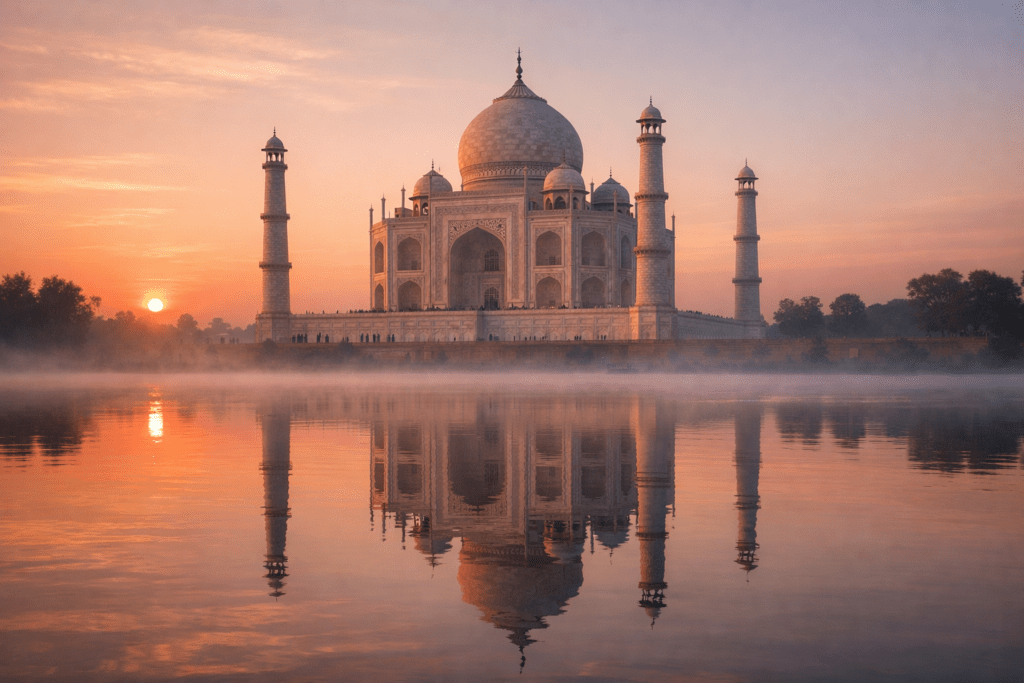
Shah Jahan and Mumtaz Mahal – The Real Story
The love story behind the Taj Mahal is often told in simple terms, but the real story has more depth.
Mumtaz Mahal, born as Arjumand Banu Begum, came from a respected Persian noble family. She married Prince Khurram (later Shah Jahan) in 1612. Although Shah Jahan had other wives—as was common for rulers of that time—Mumtaz Mahal was clearly his favorite.
What made her different was not just affection. She was:
- A trusted companion
- A confidante in personal matters
- Present during important court and military journeys
She traveled with Shah Jahan even during military campaigns, which was unusual for royal women. This closeness explains why her death affected him so deeply.
In 1631, Mumtaz Mahal died in Burhanpur while giving birth to their 14th child. The loss was sudden and devastating. Historical accounts describe Shah Jahan withdrawing into grief. His appearance changed. His interest in public life reduced for a time. The emperor, known for his control and authority, was visibly broken.
This moment is important because the Taj Mahal was not planned during calm reflection. It was born out of intense grief, when emotions were raw and personal.
Why the Taj Mahal Was Built
The Taj Mahal was not only a monument of love. It was also shaped by religious belief, architectural tradition, and imperial thinking.
In Islamic belief, paradise is described as a peaceful garden with flowing water, shade, balance, and beauty. The idea of death is not only about loss, but about the soul’s journey to a perfect afterlife. Mausoleums were often designed to reflect this vision of paradise on earth.
The Taj Mahal follows this idea closely:
- The garden represents heaven
- Water channels symbolize purity and life
- Symmetry reflects divine order
From an architectural point of view, building a grand mausoleum was a way to honor the dead while also demonstrating the ruler’s devotion and power. The Mughals had built tombs before, but Shah Jahan wanted something unmatched—something that would stand apart from all previous monuments.
There was also a political dimension. The Taj Mahal showed the world that the Mughal Empire could command resources, skill, and time on a scale few others could. It sent a quiet but powerful message: this empire was strong enough to turn personal grief into timeless beauty.
So the Taj Mahal exists because of three forces coming together:
- Love and loss on a deeply human level
- Faith and spiritual ideas about life and the afterlife
- Imperial vision, using architecture as a symbol of greatness
That combination is what makes the Taj Mahal more than a tomb. It is grief shaped by belief, and belief expressed through stone.
Construction of the Taj Mahal
When people stand before the Taj Mahal, it feels timeless—almost as if it simply appeared in its perfect form. But in reality, the Taj Mahal was the result of years of planning, patience, and human effort. Its construction was not a single event. It was a long process, carried out in stages, involving thousands of skilled hands working with remarkable coordination.
Understanding how the Taj Mahal was built helps us appreciate it not just as a symbol, but as one of the most ambitious construction projects of its time.
Timeline of Construction (1632–1653)
The construction of the Taj Mahal began around 1632, soon after Mumtaz Mahal’s death. It continued for roughly two decades, with different parts of the complex being completed at different times.
The work can be broadly understood in phases.
First phase: Preparing the foundation
The Taj Mahal stands close to the Yamuna River, which meant the ground was soft and unstable. Engineers had to first stabilize the land. They dug deep wells, filled them with stone and rubble, and created a strong base. This foundation work was crucial—without it, the monument could not have survived centuries.
Second phase: Building the main mausoleum
Once the foundation was secure, construction of the central tomb began. This included:
- The main marble structure
- The massive central dome
- The interior chambers
This phase required extreme precision, as even small errors could affect symmetry and balance.
Third phase: Supporting structures and details
After the mausoleum, attention shifted to:
- The four minarets
- The mosque and guest house
- Decorative elements like calligraphy and inlay work
Final phase: Gardens and finishing touches
The Charbagh garden, pathways, water channels, and finishing details were completed toward the end. By around 1653, the Taj Mahal complex as we know it today was largely finished.
The long timeline was not due to delay, but because the builders refused to compromise on quality.
Workforce and Skills Involved
The Taj Mahal was not built by ordinary labor alone. It was created by a carefully organized workforce made up of specialists from different regions.
Historians estimate that more than 20,000 workers and artisans were involved in the project over the years.
Each group had a specific role:
Stone carvers
These craftsmen shaped massive marble blocks and carved delicate floral patterns. Their work demanded patience and precision, as a single mistake could ruin an entire slab.
Calligraphers
The Quranic verses carved into the Taj Mahal were created by master calligraphers. The text had to be both spiritually meaningful and visually balanced. They adjusted the size of the letters carefully so that inscriptions looked uniform from ground level.
Architects
While the overall design is often attributed to Ustad Ahmad Lahori, the Taj Mahal was a collaborative effort. Architects planned proportions, symmetry, and spatial harmony across the entire complex.
Engineers
Engineers solved challenges related to:
- Weight distribution of the massive dome
- Stability near the river
- Designing minarets that could withstand earthquakes
Their solutions were practical and forward-thinking, which is why the monument still stands today.
This workforce functioned like a well-coordinated system, guided by strict supervision and high standards.
Cost and Resources
The Taj Mahal was expensive even by imperial standards.
The estimated cost during the Mughal period was around 32 million rupees. At the time, this was an enormous amount. Converting it into modern value is difficult, but it would equal several billion dollars today, depending on how calculations are made.
The resources involved were equally impressive.
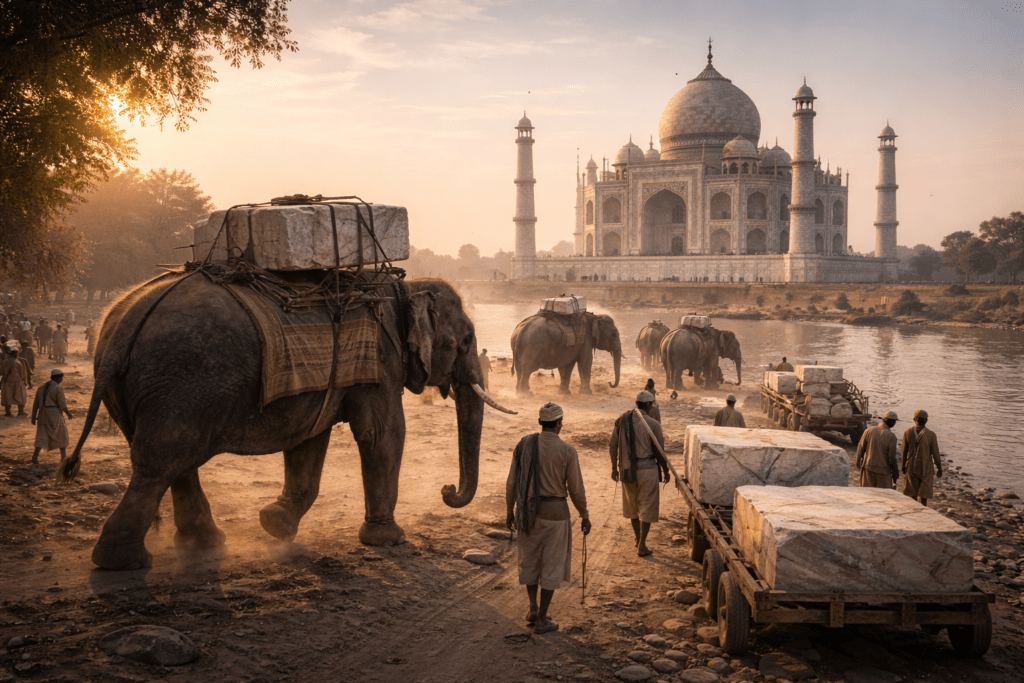
Marble and stones were transported from distant regions using:
- Carts
- Boats along rivers
- Specially constructed roads
Animals such as elephants were used to carry heavy materials. Managing this supply chain alone was a major challenge, especially in an era without modern machinery.
Despite the cost and complexity, Shah Jahan did not scale down the project. The Taj Mahal was meant to be perfect, not economical.
The result is a monument that still stands as proof of what human effort can achieve when skill, resources, and vision come together.
Architectural Genius of the Taj Mahal
The Taj Mahal looks effortless when you see it. Calm. Balanced. Almost weightless.
But that feeling comes from careful design, not chance.
Behind the beauty is a deep understanding of architecture, geometry, engineering, and symbolism. The Taj Mahal is not just something built to look good—it was designed to feel right to the human eye and mind.
Architectural Style and Influences
The Taj Mahal is often described as Mughal architecture, but that label hides how layered it really is. What makes the monument extraordinary is how different traditions were brought together and made to feel like one language.
Persian influence
The strongest influence comes from Persian architecture. You can see it in:
- The large central dome
- The tall arched entrances (iwans)
- The emphasis on symmetry and balance
Persian design traditions focused on harmony and order, and the Taj Mahal reflects that idea clearly. Nothing feels crowded. Nothing feels random.
Islamic symmetry
Islamic architecture places great importance on symmetry and repetition, as a reflection of divine order. The Taj Mahal follows this idea almost perfectly. Each side mirrors the other. Each structure has a visual twin.
This symmetry is not only aesthetic. It creates a sense of calm and stability, which is why visitors often feel peaceful even in a crowded space.
Indian craftsmanship
While the overall planning shows Persian and Islamic influence, the hands that brought it to life were largely Indian. The floral designs, stone inlay work, and carving techniques come from local traditions refined over generations.
The Taj Mahal is not foreign architecture placed in India. It is a conversation between cultures, shaped by the land and people who built it.
Layout and Geometry
If the Taj Mahal feels perfectly balanced, it’s because geometry controls almost everything about it.
Charbagh garden concept
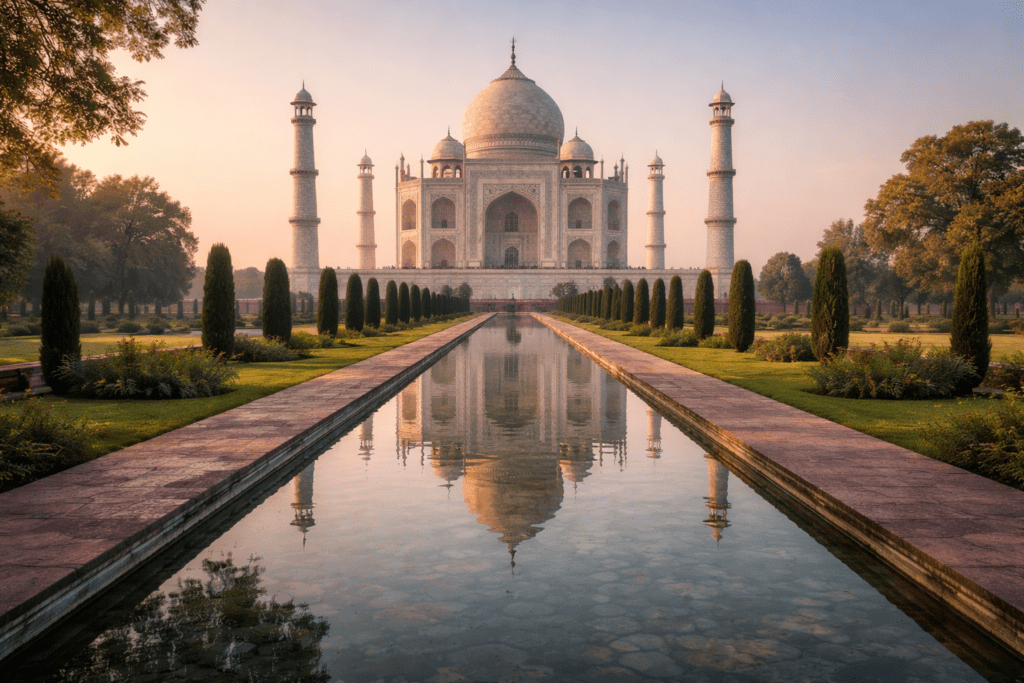
The Taj Mahal complex is laid out as a Charbagh, a four-part garden divided by water channels. This design comes from Islamic ideas of paradise, described as a garden with flowing rivers, shade, and order.
The garden is not decoration. It prepares the visitor mentally. As you walk through it, the noise of the outside world slowly fades, and the monument reveals itself step by step.
Axis symmetry and central alignment
The Taj Mahal is aligned along a central axis. The main tomb sits exactly on this line, creating a sense of visual stability. Even the reflection pool in front of it is placed to draw the eye straight to the monument.
Every structure on one side has a matching structure on the other—except for one deliberate change added later.
Spiritual symbolism
The geometry of the Taj Mahal is tied to belief. Balance represents divine order. Repetition suggests eternity. Light symbolizes purity. Water reflects both the monument and the sky, blurring the boundary between earth and heaven.
This is why the Taj Mahal feels spiritual even to people who don’t share the same religious background.
Engineering Innovations
The Taj Mahal is admired for beauty, but it survives because of smart engineering.
Foundation techniques near the Yamuna River
Building such a massive structure near a river was risky. The ground was soft and unstable. Mughal engineers solved this by digging deep wells and filling them with stone and rubble to create a strong, flexible foundation.
This method allowed the structure to adjust slightly over time without collapsing—one reason it has survived for centuries.
Load distribution of the dome
The central dome looks massive, yet it does not crush the structure beneath it. This is because its weight is carefully distributed through arches and supporting walls. The dome’s shape spreads pressure evenly, reducing stress on any one point.
It is heavy, but it behaves intelligently.
Earthquake-resistant features
The four minarets are slightly tilted outward. This was done on purpose. In case of an earthquake, the minarets would fall away from the main tomb, protecting the core structure.
This shows that the builders were not only thinking about beauty—but about the future.
The architectural genius of the Taj Mahal lies in this balance:
emotion and logic, beauty and structure, belief and mathematics.
It is not fragile poetry in stone.
It is disciplined engineering shaped into art.
Materials Used in the Taj Mahal
When people admire the Taj Mahal, they often say, “It looks like it’s made of pure white light.”
That reaction comes directly from the materials chosen to build it.
The Taj Mahal was not constructed using whatever was easily available. Every material was selected with care—for strength, beauty, symbolism, and how it would age over time. The builders were thinking not just about how the monument would look on the day it was finished, but how it would look centuries later.
Makrana Marble
The most famous material used in the Taj Mahal is Makrana marble, sourced from the town of Makrana in present-day Rajasthan.
Why this marble was chosen
Makrana marble was not the closest or cheapest option. It was chosen because of its exceptional quality. Compared to other types of marble available at the time, Makrana marble was:
- Extremely pure
- Fine-grained and strong
- Less prone to cracking
This marble could be carved deeply without breaking, which was essential for detailed floral patterns, inscriptions, and smooth surfaces.
Transporting it was not easy. Large marble blocks were moved over long distances using carts, river routes, and animals like elephants. The effort involved shows how important quality was to the project.
Durability and light reflection
One of the most remarkable qualities of Makrana marble is how it interacts with light. It does not simply reflect light like a mirror. Instead, it allows light to penetrate slightly beneath the surface and scatter softly.
This is why:
- The Taj Mahal appears pinkish at sunrise
- Bright white at midday
- Golden at sunset
- Silvery under moonlight
This changing appearance is not paint or illusion. It is the natural behavior of the stone.
Another reason Makrana marble was chosen is durability. Even after hundreds of years, much of the marble has retained its strength and smoothness. While pollution has caused discoloration in places, the stone itself remains remarkably resilient.
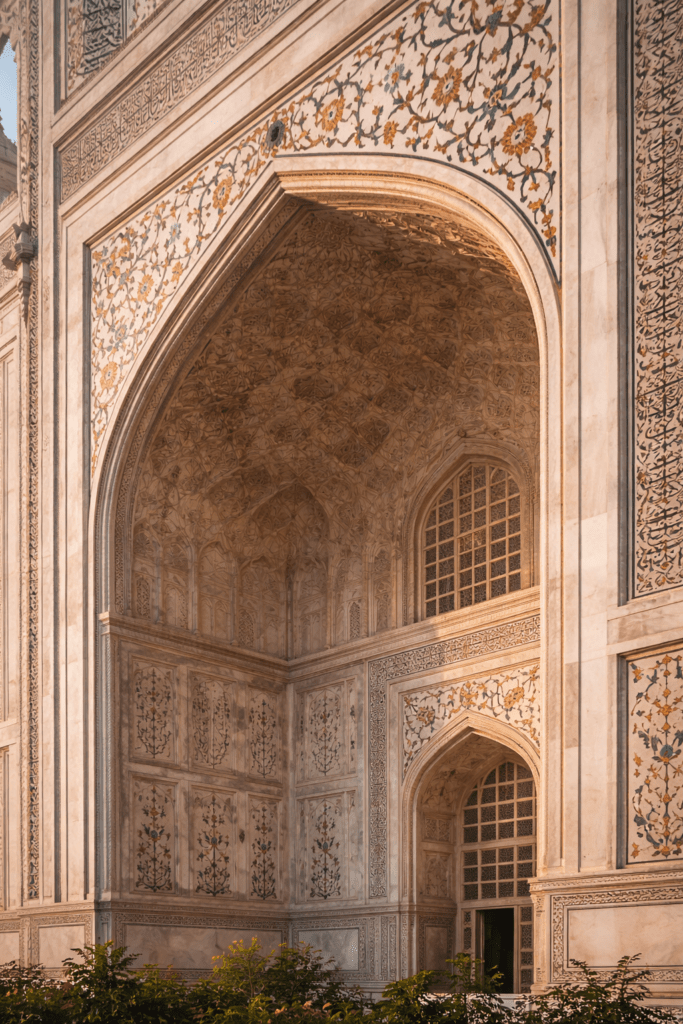
Semi-Precious Stones and Inlay Work
If marble is the body of the Taj Mahal, the inlay work is its soul.
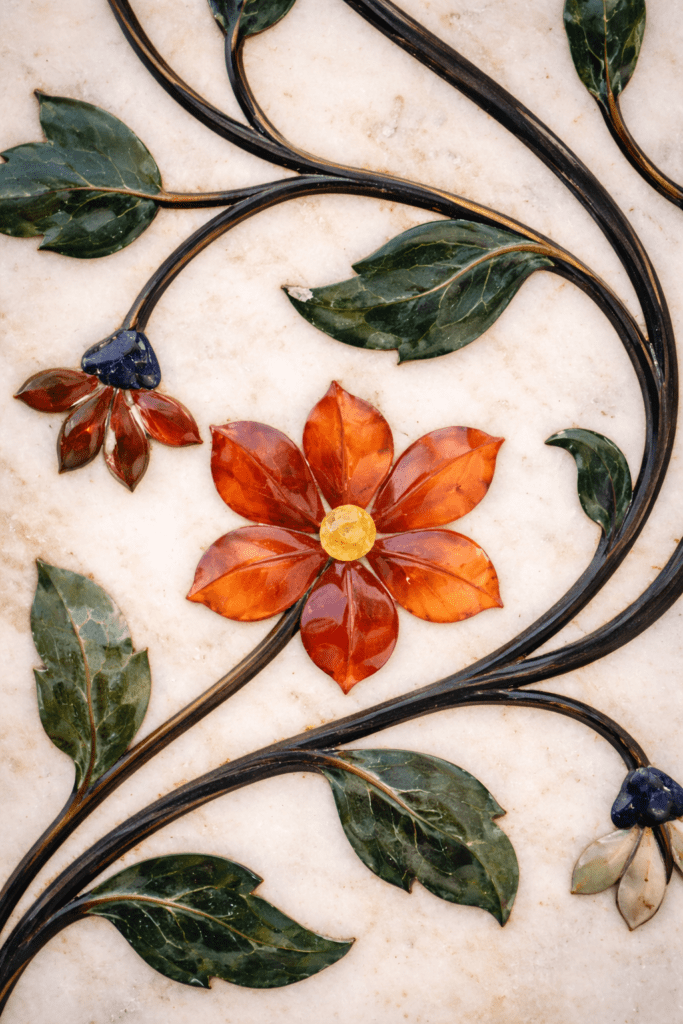
Look closely at the walls, arches, and panels, and you’ll see flowers, vines, and leaves formed from colored stones set into white marble. This is not surface decoration. These stones are embedded into the marble itself.
Types of stones used
Artisans used a wide range of semi-precious stones, including:
- Jasper
- Jade
- Lapis lazuli
- Carnelian
- Onyx
- Turquoise
These stones came from different regions across Asia, showing how wide the Mughal trade and supply network was. Each stone was chosen not only for color, but for how well it could be cut and polished.
Pietra dura technique
The technique used for this work is known as pietra dura. It involves:
- Cutting marble panels precisely
- Carving shallow grooves in the desired design
- Shaping tiny stone pieces to fit perfectly
- Placing and polishing them until the surface feels seamless
Once finished, you cannot easily feel where the marble ends and the stone begins.
This technique required extraordinary skill. One wrong cut could ruin weeks of work.
Time and precision involved
Every floral design you see on the Taj Mahal was made by hand. No machines. No shortcuts.
What makes this even more astonishing is that no two inlay designs are exactly the same. Artisans were not copying patterns endlessly. They were creating variations, each slightly different, each balanced in its own way.
This level of detail explains why construction took so long. Speed was never the goal. Perfection was.
The materials of the Taj Mahal tell us something important about its creators.
They did not build it to impress for a moment.
They built it to endure.
Stone by stone, color by color, the Taj Mahal was shaped with patience, discipline, and respect for craft. That is why, centuries later, it still feels alive—changing with the light, responding to the sky, and quietly reminding us what careful human work can achieve.
10 Shocking and Lesser-Known Facts About the Taj Mahal
The Taj Mahal is one of the most photographed buildings on Earth. And yet, much of what makes it extraordinary is easy to miss unless someone slows down and explains it.
These facts are not rumors or dramatic legends. They are details rooted in history, science, and observation—things that quietly reveal how thoughtful and complex this monument really is.
Fact 1: The Taj Mahal Changes Color Naturally
Many visitors feel that the Taj Mahal looks different every time they see it. That feeling is real.
Scientific reasons
The marble used in the Taj Mahal has a fine grain and slight translucence. Light doesn’t just bounce off the surface—it enters the stone and scatters softly. This interaction changes how the monument appears at different times of day.
Environmental factors
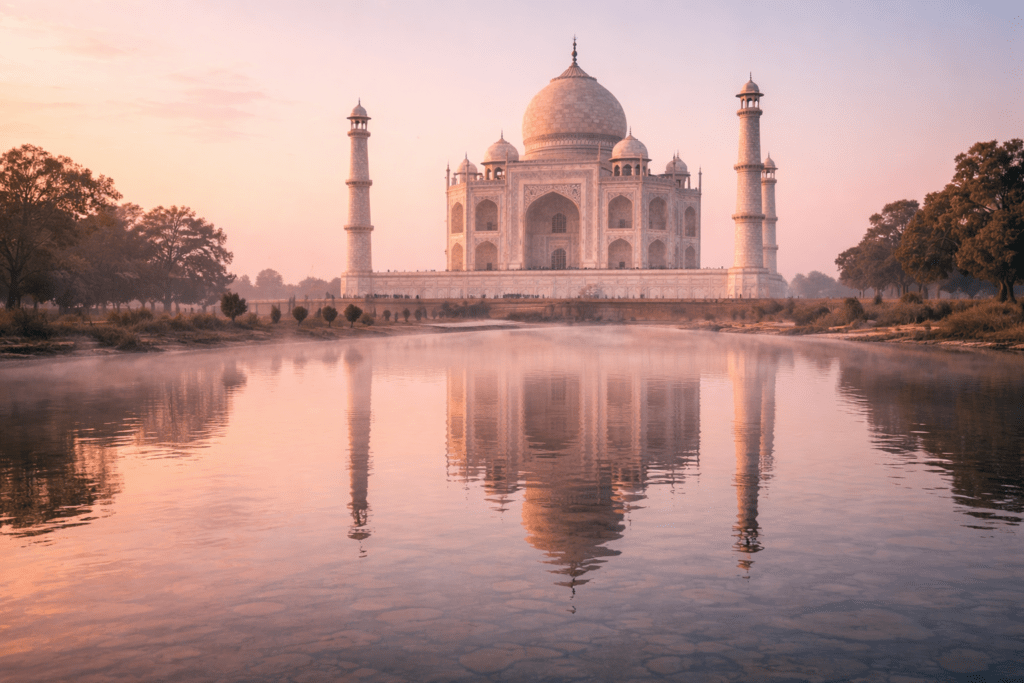
- At sunrise, the marble often looks soft pink
- At noon, it appears bright white
- At sunset, it turns warm and golden
- Under moonlight, it takes on a silver-blue glow
This color change is not paint, polish, or illusion. It is the natural behavior of high-quality marble responding to light, air, and moisture.
Fact 2: The Minarets Are Intentionally Tilted
At first glance, the four minarets look straight. Look closer, and you’ll notice they lean slightly outward.
Earthquake safety
This tilt was done on purpose. In case of an earthquake, the minarets were designed to fall away from the main tomb rather than collapse onto it.
Structural foresight
This decision shows that Mughal engineers were thinking beyond appearance. They were planning for natural disasters long before modern seismic science existed.
Fact 3: The Calligraphy Is an Optical Illusion
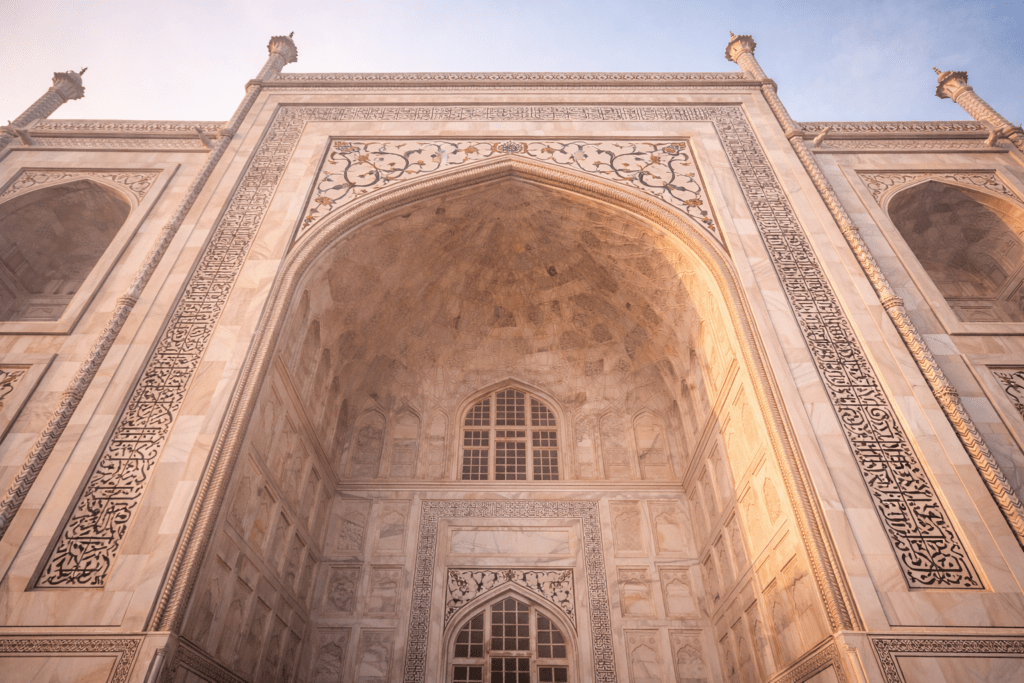
The Quranic verses on the Taj Mahal appear perfectly uniform when viewed from the ground.
Letter size variation
In reality, the letters increase in size as they go higher. The calligrapher adjusted each line carefully so that perspective would make everything look balanced.
Visual balance
This technique required deep understanding of human vision. It proves that the builders were designing not just structures, but the way people would experience them.
Fact 4: The Tombs Visitors See Are Not the Real Graves
Inside the main chamber, visitors see two beautifully decorated tombs. These are not the actual burial sites.
Cenotaph concept
The visible tombs are cenotaphs, symbolic memorials placed for public viewing.
Actual burial chamber
The real graves of Mumtaz Mahal and Shah Jahan are located in a lower chamber beneath the main floor. They are simple and unadorned, in keeping with Islamic burial traditions.
This contrast between the ornate public space and the humble private burial is intentional.
Fact 5: Shah Jahan Was Imprisoned by His Son
The story of the Taj Mahal does not end with its completion.
Aurangzeb’s takeover
In 1658, Shah Jahan was deposed by his son Aurangzeb during a struggle for power.
Shah Jahan’s final years
He spent the last eight years of his life confined in Agra Fort, where he could see the Taj Mahal from a small window. After his death, he was buried beside Mumtaz Mahal—slightly breaking the monument’s perfect symmetry.
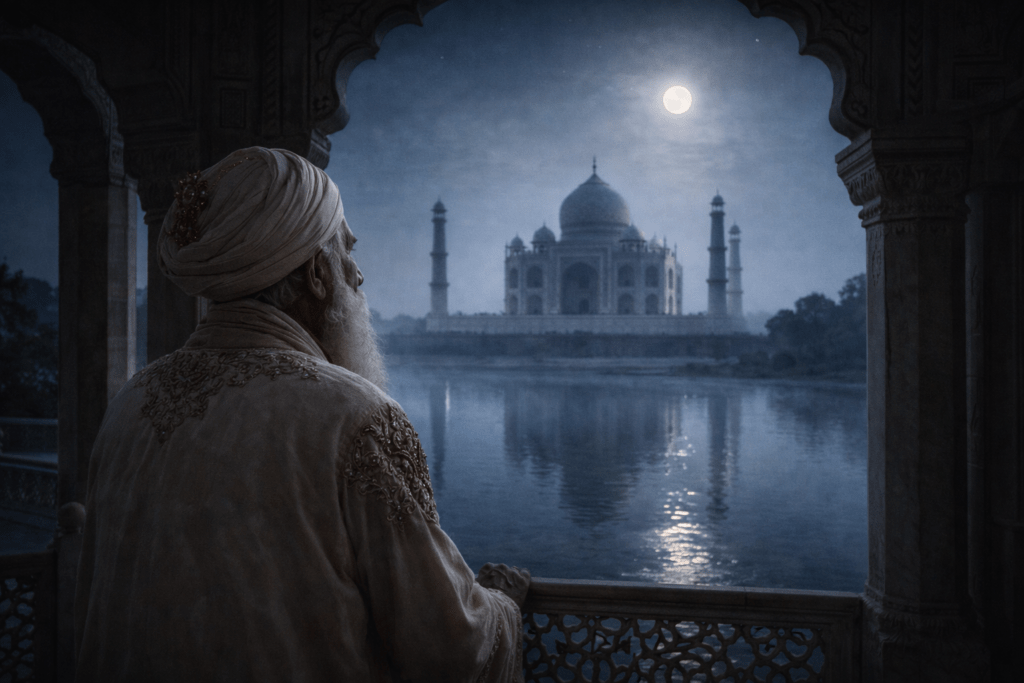
Fact 6: The Taj Mahal Was Once Part of a Living City
Today, the Taj Mahal feels like a standalone monument. In the past, it was part of an active urban area.
Taj Ganj area
The neighborhood around the Taj, known as Taj Ganj, housed workers, traders, and pilgrims.
Mughal urban planning
The Taj Mahal was integrated into the city’s life, connected by roads, markets, and river routes. It was not isolated from society—it was part of it.
Fact 7: No Two Decorative Patterns Are the Same
The floral designs carved and inlaid into the Taj Mahal may look repetitive, but they are not.
Handcrafted uniqueness
Every flower, leaf, and vine was created by hand. Artisans did not copy templates endlessly.
Artistic discipline
They followed a shared style but introduced subtle variations, ensuring that no two patterns are identical. This level of discipline required patience and extraordinary skill.
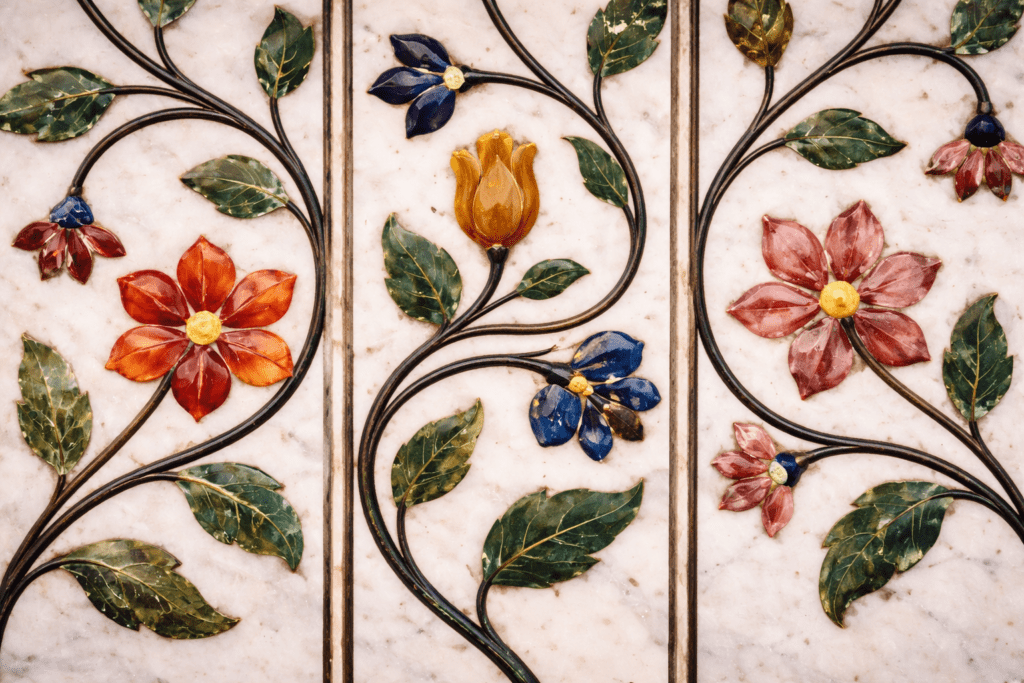
Fact 8: The Dome’s Acoustics Are Unique
The interior of the Taj Mahal’s dome behaves in an unusual way.
Echo phenomenon
A single sound—like a soft clap—can echo multiple times inside the chamber.
Purpose and effect
This acoustic effect enhances the feeling of space and stillness. It encourages silence and reflection, making the chamber feel almost otherworldly.
Fact 9: The Taj Mahal Has Faced Serious Environmental Threats
The Taj Mahal’s biggest enemy today is not war—it is the modern environment.
Pollution
Air pollution from nearby industries and vehicles has caused yellowing and stains on the marble.
River degradation
The Yamuna River, once a vital part of the monument’s setting, has suffered reduced flow and pollution, affecting the foundation’s environment.
Preservation measures
To protect the Taj, authorities have:
- Restricted vehicle traffic nearby
- Relocated polluting industries
- Used clay-based cleaning methods on marble surfaces
Fact 10: The Monument Lost Its Original Surroundings Over Time
What you see today is not exactly what early visitors saw.
Colonial modifications
During British rule, parts of the original Mughal garden layout were altered to resemble English-style lawns.
Garden redesigns
Some original features were removed or reshaped, changing how the monument related to its landscape. Modern restoration efforts aim to respect the original intent as much as possible.
These ten facts reveal something important.
The Taj Mahal is not mysterious because it hides secrets.
It is remarkable because every visible detail has a reason behind it.
The more you understand it, the more human it becomes—built from love, belief, intelligence, and patience, all working together across time.
Myths vs Historical Reality
The Taj Mahal has stood for centuries, and with time, stories have grown around it. Some are romantic. Some are dark. Some are repeated so often that people accept them as truth without ever questioning them.
This section gently separates what actually happened from what sounds dramatic but lacks evidence. The real history of the Taj Mahal is powerful enough—it doesn’t need exaggeration.
Were Workers’ Hands Really Cut Off?
This is one of the most repeated stories about the Taj Mahal. Many guides and articles claim that Shah Jahan ordered the hands of workers to be cut off so they could never build something similar again.
Origin of the myth
This story likely emerged much later, possibly during colonial times, when travelers and writers often described Eastern rulers as cruel and extreme. The idea suited dramatic storytelling and was passed on without solid proof.
Historical evidence
There is no reliable historical record—no court document, no Mughal chronicle, no contemporary account—that supports this claim. The Mughal administration depended on skilled artisans across many projects. Crippling thousands of craftsmen would have been impractical and damaging to the empire itself.
Historians agree that while working conditions were harsh by modern standards, the story of mass mutilation is a myth, not a proven fact.
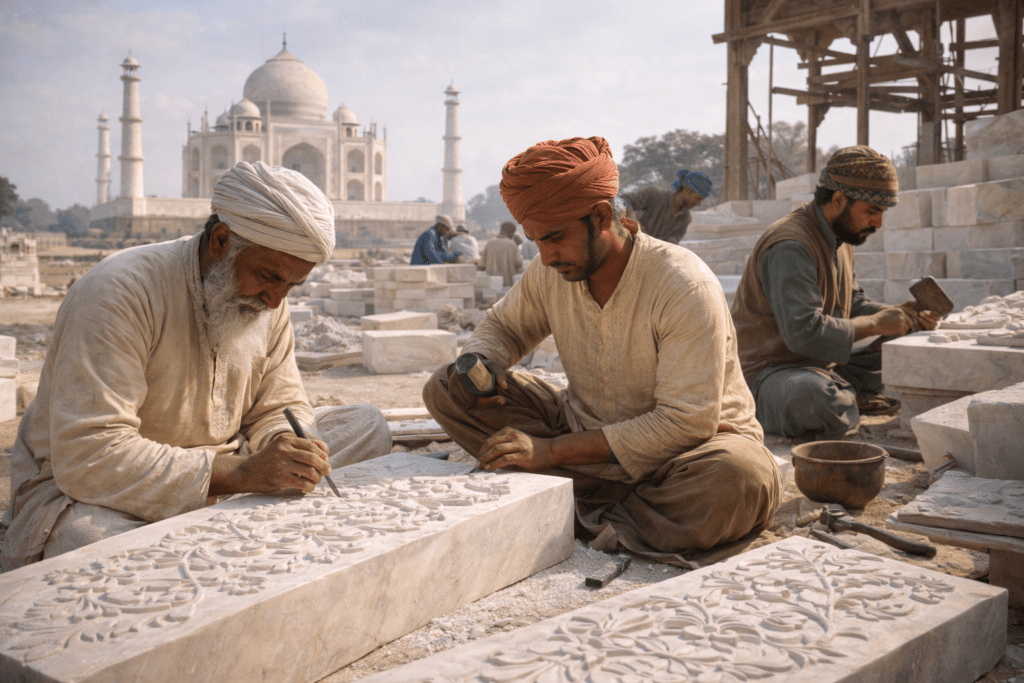
The Black Taj Mahal Story
Another popular legend claims that Shah Jahan planned to build a second Taj Mahal made of black marble across the Yamuna River for himself.
Where the legend came from
This story is often linked to the observations of European travelers, particularly accounts describing dark-colored remains on the opposite riverbank. Over time, imagination filled the gaps, turning shadows and ruins into a dramatic second monument.
Archaeological findings
Modern archaeological studies suggest that the dark remains were likely discolored white marble or unfinished structures, not evidence of a planned black Taj Mahal. No Mughal-era blueprint, order, or inscription confirms such a project.
Most historians today consider the Black Taj Mahal to be a romantic legend, not a historical plan.
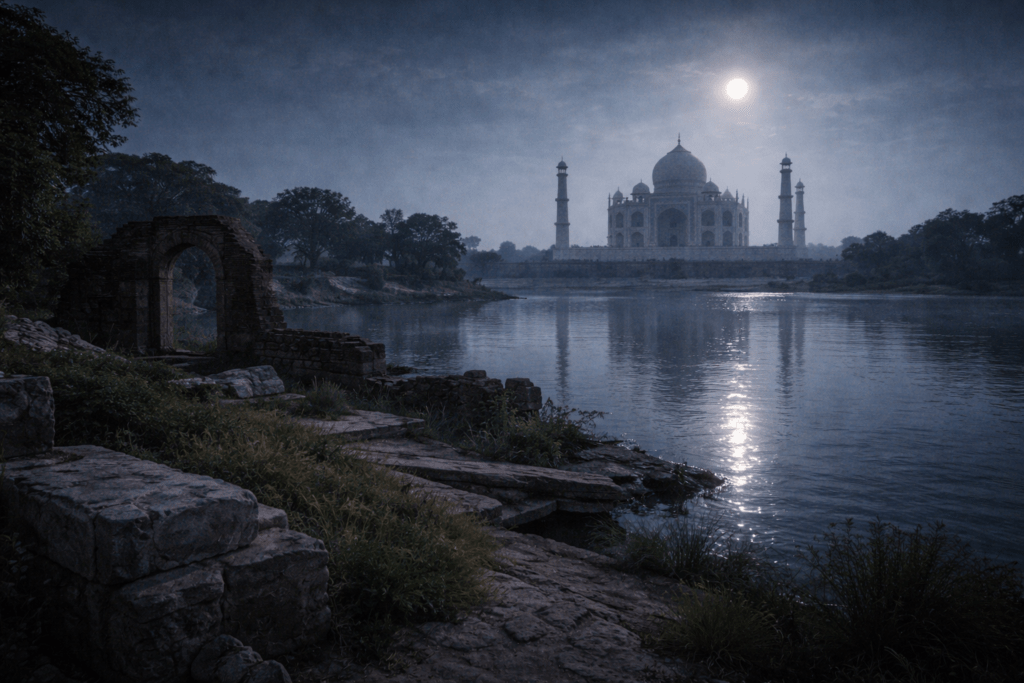
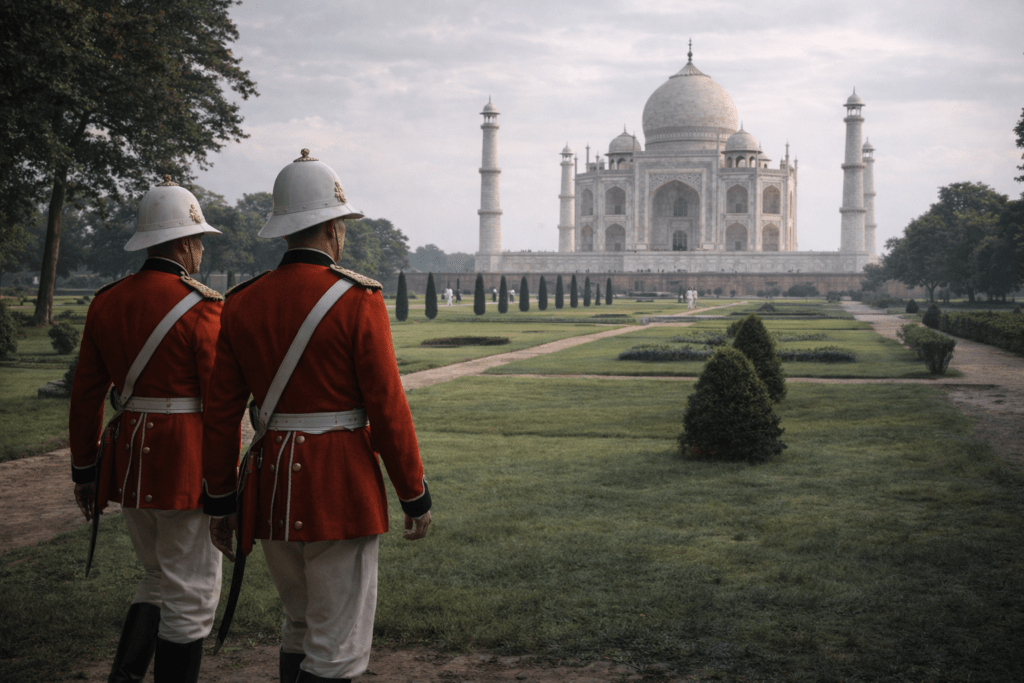
British Plans to Destroy the Taj Mahal
It is often said that the British wanted to demolish the Taj Mahal and sell its marble.
What actually happened
During British rule, parts of the Taj complex were neglected, and some surrounding structures were altered. There are records of marble being removed from other Mughal buildings in India, which fuels this belief.
However, there is no confirmed plan to dismantle the Taj Mahal itself. In fact, some British officials later took steps to preserve it, even if their approach altered the original Mughal landscape.
Exaggerations vs facts
The idea of fully auctioning or destroying the Taj Mahal appears to be an exaggeration. What did happen was:
- Changes to garden layouts
- Periods of neglect
- Limited understanding of Mughal design philosophy
These actions affected the monument, but they were not the same as planning its destruction.
Why These Myths Matter
Myths often survive because they are shocking or emotional. But when we repeat them without questioning, we lose sight of the real achievement behind the Taj Mahal.
The truth is simpler—and more impressive.
The Taj Mahal was not built through cruelty alone.
It was built through organization, skill, discipline, and vision.
Its history deserves understanding, not exaggeration.
Knowing the difference between myth and reality allows us to respect the monument—and the people who created it—for what they truly were.
Religious and Symbolic Meaning of the Taj Mahal
The Taj Mahal is often admired for its beauty, but beneath the marble and symmetry lies a deep spiritual language. It was not designed only to be seen—it was designed to be understood, especially through the lens of faith.
For Shah Jahan and the architects of his time, architecture was a way to express beliefs about life, death, and what comes after. The Taj Mahal quietly communicates these ideas through words, space, water, and light.
Quranic Inscriptions and Their Meaning
As you approach the Taj Mahal, one of the first details you notice—often without fully reading it—is the calligraphy.
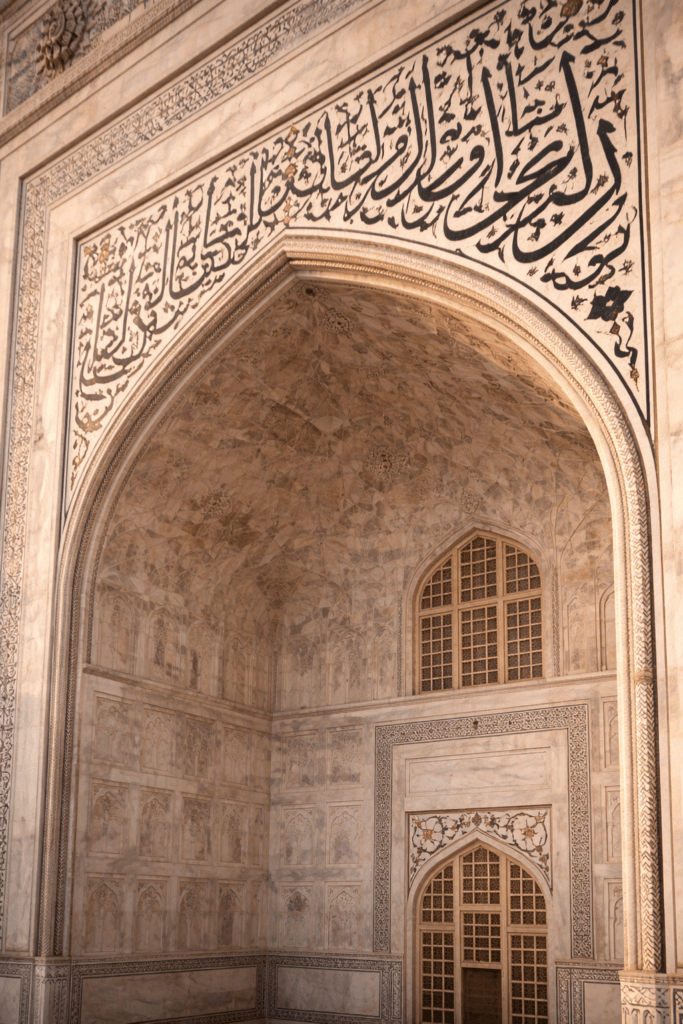
These inscriptions are verses from the Quran, carefully chosen and placed around entrances and interior walls. They are not random decorations. Each verse has meaning, and together they form a spiritual message.
Themes of judgment and paradise
Many of the Quranic verses inscribed on the Taj Mahal speak about:
- The Day of Judgment
- God’s mercy
- The promise of paradise for the faithful
One of the most significant aspects is that the main entrance is framed by verses that symbolically invite the soul to enter paradise. In simple terms, the building itself acts like a gateway—from the world of the living into the peace of the afterlife.
The calligraphy grows slightly larger as it rises upward. This ensures that the text looks balanced from the ground, but it also carries a symbolic meaning: as one looks upward, the message becomes clearer and more complete—just as spiritual understanding is believed to grow as the soul moves closer to God.
Importantly, the inscriptions focus on hope, mercy, and eternal peace, not fear. This reflects the purpose of the Taj Mahal as a resting place, not a monument of sorrow alone.
Symbolism of Gardens, Water, and Light
The Taj Mahal does not end with the building. Its meaning unfolds as you walk through the complex.
Every element around the monument plays a role in expressing an idea of heaven on earth.
Islamic view of heaven
In Islamic tradition, paradise is often described as a garden—a place of shade, flowing water, balance, and peace. The Taj Mahal’s layout reflects this vision.
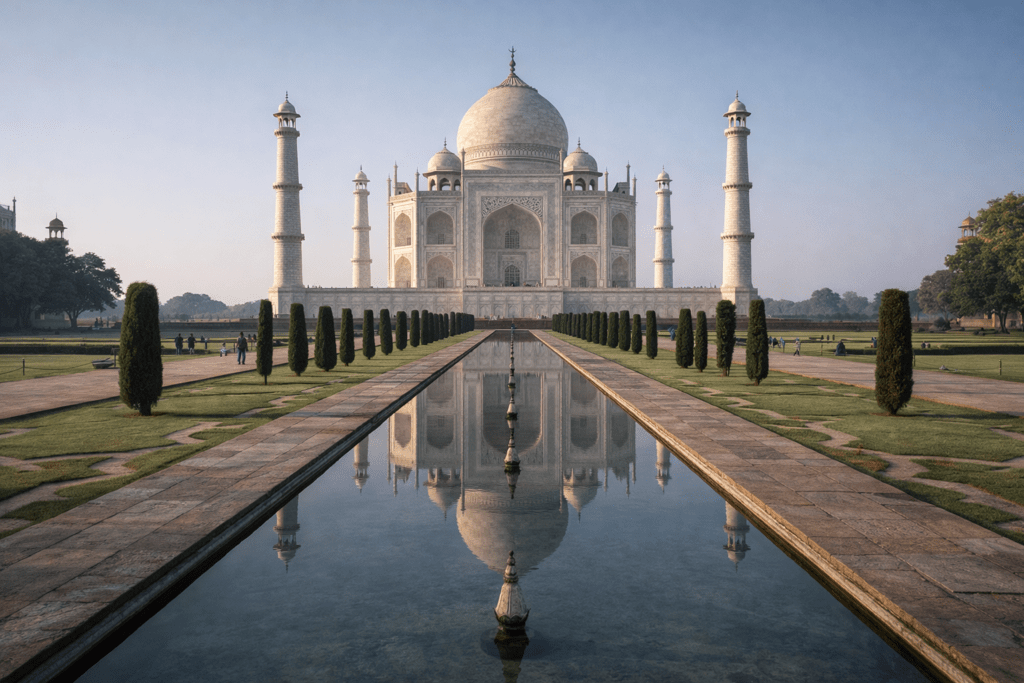
The Charbagh garden, divided into four equal parts, represents an idealized version of paradise. The symmetry suggests divine order. The straight paths guide the visitor calmly forward, away from chaos and toward stillness.
This is not a wild garden. It is controlled, balanced, and intentional—mirroring the belief that paradise is a place of harmony.
Reflection pools
Water plays a central symbolic role.
The long reflection pools do more than mirror the Taj Mahal’s image. They:
- Represent purity
- Reflect the sky, blending earth and heaven
- Create a sense of stillness and introspection
As the monument reflects in the water, it appears almost weightless, as if floating between worlds. This visual effect reinforces the idea that the Taj Mahal is not just a structure of stone, but a bridge between the physical and the spiritual.
Light as a symbol
Light is used carefully throughout the design. The white marble responds to sunlight, moonlight, and shadow in subtle ways. This constant change reflects the passage of time, while the monument itself remains still—suggesting eternity beyond time.
Together, garden, water, and light work quietly. They do not demand attention. They guide emotion.
Why This Symbolism Matters
The Taj Mahal was never meant to be loud in its message.
Its religious meaning is gentle. It does not instruct. It invites.
It invites the visitor to slow down.
To reflect.
To think about life, loss, and peace beyond death.
This is why the Taj Mahal continues to move people from every background. Even without reading the inscriptions or knowing the symbolism, visitors often feel something calm and timeless.
That feeling is not accidental.
It is architecture speaking the language of faith.
Taj Mahal as a UNESCO World Heritage Site
By the time the modern world began talking seriously about heritage and preservation, the Taj Mahal had already survived wars, changing rulers, and centuries of wear. What remained was a question the world had to answer together: How do we protect something that belongs to everyone, but stands in one place?
This is where UNESCO enters the story.
Year and Criteria for UNESCO Listing
The Taj Mahal was declared a UNESCO World Heritage Site in 1983. This recognition was not given lightly. UNESCO lists only those places that carry exceptional value for all humanity, not just for one country or culture.
Cultural importance
The Taj Mahal was recognized as a masterpiece of human creativity. It represents:
- The peak of Mughal architectural achievement
- A successful blending of Persian, Islamic, and Indian traditions
- A monument where art, engineering, and spiritual meaning exist together
It is not important only because of who built it, but because of how it was built—with intention, discipline, and vision.
Universal value
UNESCO also considers whether a place speaks beyond its local or national boundaries. The Taj Mahal does exactly that.
People from different cultures, religions, and languages connect with it emotionally. Some see love. Some see loss. Some see faith. Others see technical brilliance. This ability to hold many meanings at once is what gives the Taj Mahal its universal value.
It is not a monument that demands interpretation. It allows it.
Preservation Rules and Challenges
UNESCO recognition does not freeze a monument in time. It creates responsibility.
Preserving the Taj Mahal is an ongoing effort, and it comes with difficult choices.
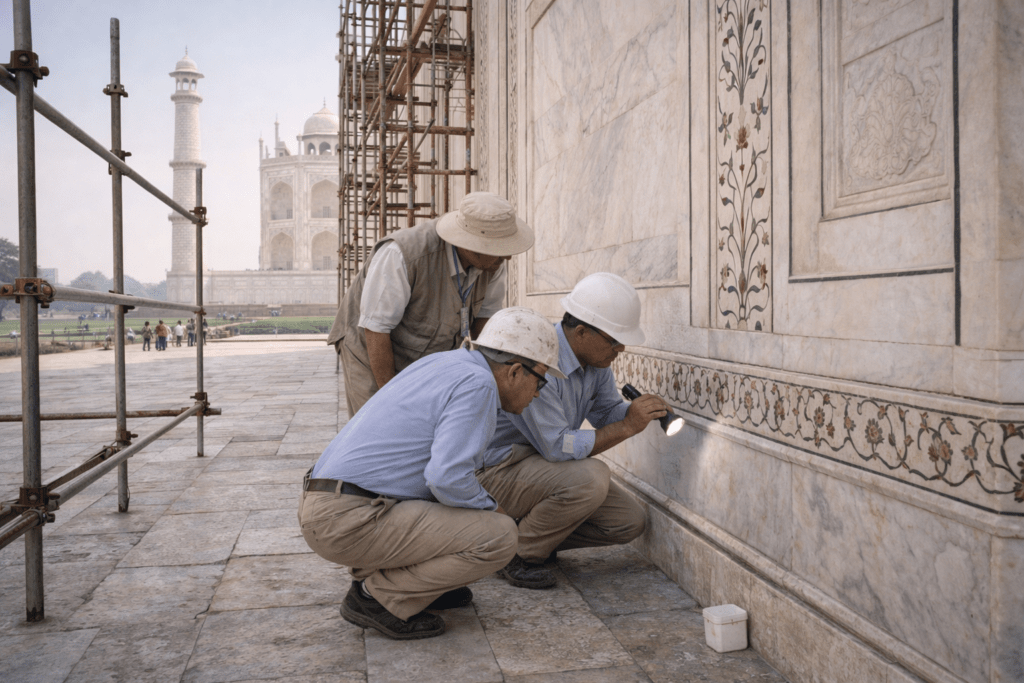
Modern conservation efforts
Over the years, conservation teams have worked to protect the monument without changing its character. Some key efforts include:
- Careful cleaning of marble surfaces using non-damaging methods
- Continuous monitoring of structural stability
- Scientific studies of how pollution and moisture affect the stone
The goal is not to make the Taj Mahal look “new,” but to help it age with dignity.
Restrictions on visitors and industries
One of the biggest challenges is human pressure.
Millions of visitors come each year. While tourism helps people connect with the monument, it also brings:
- Physical wear
- Increased pollution
- Stress on the surrounding environment
To reduce damage, authorities have introduced:
- Limits on visitor movement in sensitive areas
- Restrictions on vehicles near the monument
- Controls on industrial activity around Agra
These measures are not always popular, but they are necessary. The Taj Mahal cannot speak for itself. Protection requires rules.
Why UNESCO Status Matters Today
UNESCO recognition reminds us of something important:
The Taj Mahal does not belong only to history books.
It belongs to the present—and the future.
Preserving it is not about keeping tourists happy or maintaining a postcard image. It is about respect: respect for craftsmanship, for memory, and for the idea that some human creations are worth protecting even when it is difficult.
The Taj Mahal has survived because people cared enough to protect it.
Its future depends on that care continuing.
Best Time and Way to Visit the Taj Mahal
Visiting the Taj Mahal is not just about arriving there.
When and how you visit can completely change the experience.
The Taj Mahal is the same building every day, yet it feels different depending on the light, the season, and the time you choose to walk through its gates. Understanding this helps you see it not as a rushed tourist stop, but as a place to be experienced slowly.
Best Time of Day
The Taj Mahal is open from sunrise to sunset (except Fridays), but not all hours are equal.
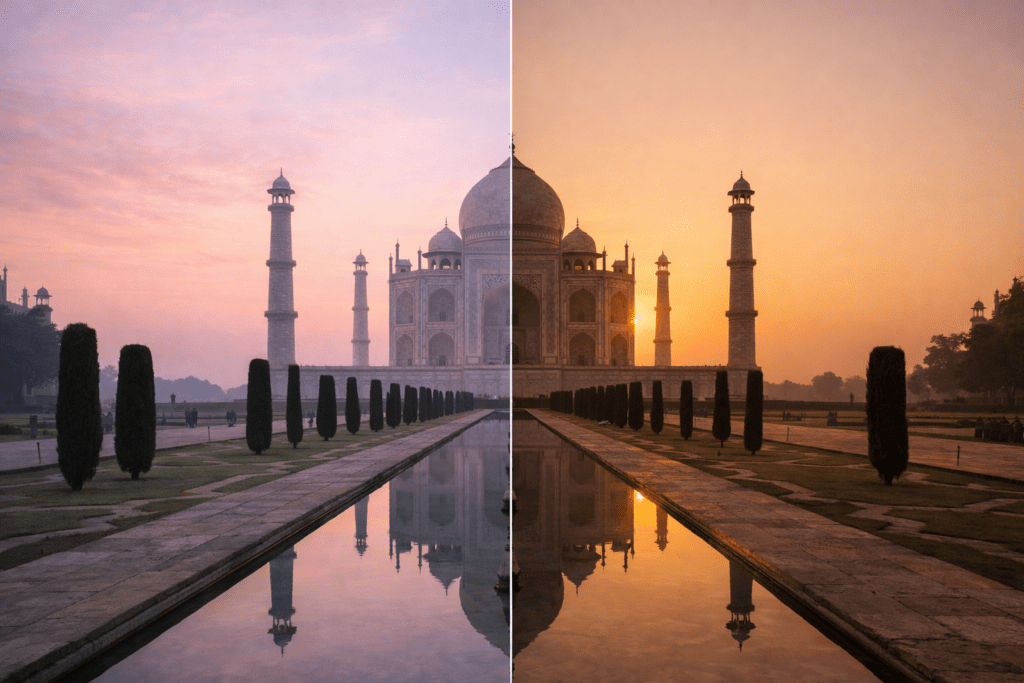
Sunrise
For many visitors, sunrise is the most rewarding time to see the Taj Mahal.
- The air is cooler and calmer
- Crowds are usually lighter
- The marble takes on soft pink and pale gold tones
- The atmosphere feels quiet and almost private
As the sun rises, the monument slowly reveals its details. This gradual change in light allows you to notice carvings, inlay work, and reflections that are easy to miss later in the day.
Sunrise visits are ideal if you want to feel the emotional side of the Taj Mahal.
Sunset
Sunset has its own beauty.
- The marble turns warm and golden
- Long shadows add depth to the structure
- The gardens look dramatic in fading light
However, sunset hours tend to be more crowded. Many people arrive after daytime sightseeing, which can make the experience feel busier and louder.
Sunset works well if you enjoy photography and don’t mind sharing the space with others.
Best Season to Visit
The Taj Mahal can be visited all year, but the season affects comfort more than beauty.
Winter months (October to February)
This is generally the most comfortable period.
- Cool mornings and evenings
- Pleasant daytime temperatures
- Better conditions for walking and exploring
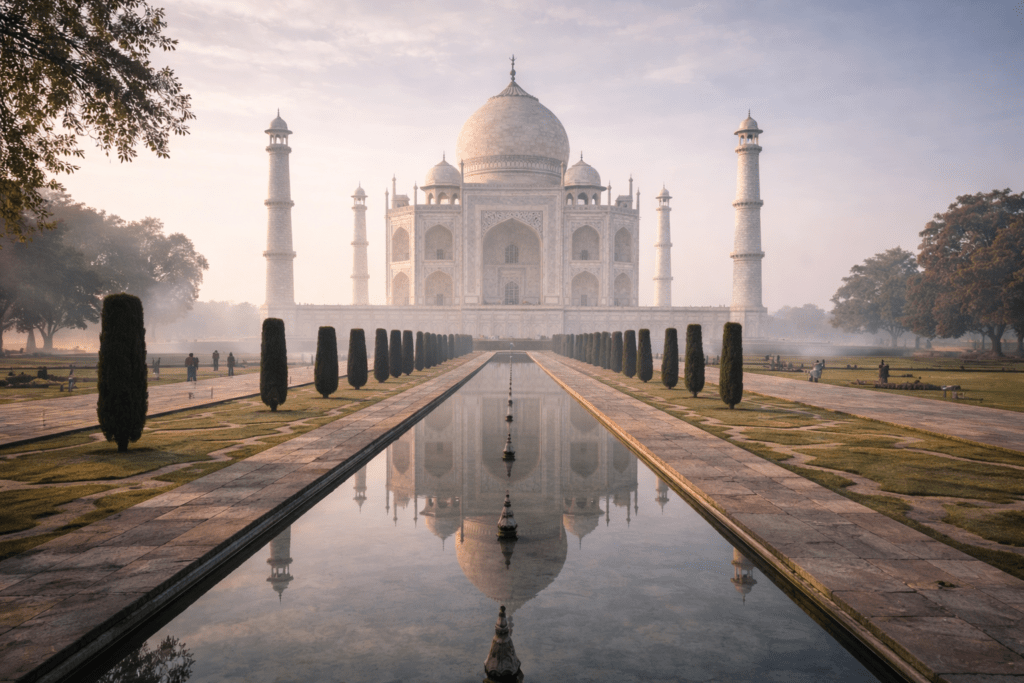
Light fog may appear on some winter mornings, which can delay visibility but also creates a soft, dream-like atmosphere when it clears.
Summer months (March to June)
Summers in Agra can be extremely hot.
- High temperatures, especially in the afternoon
- Strong sunlight and fatigue
If visiting in summer, early morning is essential. Midday visits can be physically exhausting.
Monsoon season (July to September)
Rain brings relief from heat but also humidity.
- Lush greenery in gardens
- Fewer tourists
- Occasional heavy rain
Monsoon visits can be peaceful but unpredictable.
Full Moon Night Viewing
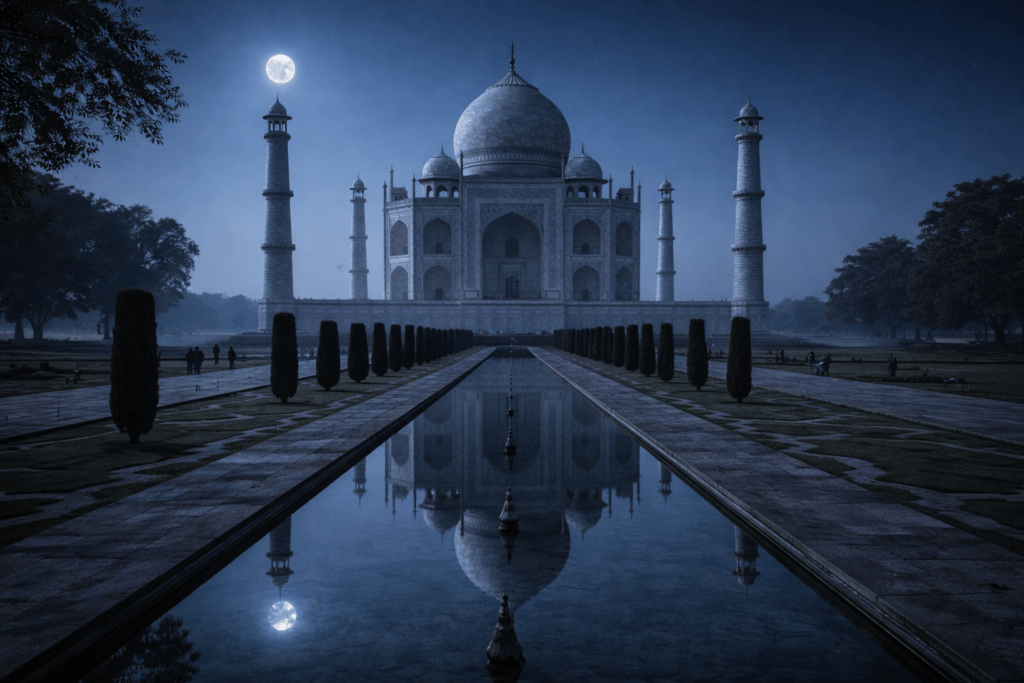
One of the most special ways to experience the Taj Mahal is during full moon night viewing.
Rules
- Night viewing is allowed on five nights each month
- Full moon night
- Two nights before
- Two nights after
- Entry is strictly timed
- Visitor numbers are limited
- Tickets must be booked in advance
Photography is usually restricted during night viewing to protect the monument and manage security.
Experience
Under moonlight, the Taj Mahal looks completely different.
- The marble glows softly
- Details appear gentler
- The monument feels distant from time
There is less noise, less movement, and more silence. Many visitors describe this experience as deeply emotional, even spiritual.
Night viewing is not about seeing every detail. It is about feeling the monument.
A Simple Tip Before You Go
The Taj Mahal rewards patience.
Arrive early.
Walk slowly.
Pause often.
The best way to visit is not to rush through it, but to let it unfold—one arch, one reflection, one moment of silence at a time.
Practical Travel Tips for Visitors
A visit to the Taj Mahal becomes much smoother when you know what to expect. These are not complicated rules, but simple guidelines that help protect the monument and allow everyone to experience it with respect.
Entry Rules and Security
Security at the Taj Mahal is strict, and for good reason. It is one of the most visited monuments in the world.
What is allowed
- Mobile phones
- Small purses or wallets
- A small transparent water bottle
- Personal medical items if necessary
What is not allowed
- Large bags or backpacks
- Food items
- Cigarettes, lighters, or tobacco
- Tripods, drones, or professional camera equipment
- Sharp objects or electronics beyond basic use
Security checks happen before entry, so arriving early helps avoid long queues.
Dress Code and Visitor Etiquette
There is no enforced dress code, but modest clothing is strongly encouraged.
- Cover shoulders and knees
- Wear comfortable clothes and walking shoes
- Shoes must be removed or covered inside the main mausoleum
Inside the central chamber, people naturally lower their voices. This space is a tomb, not just a viewing hall. Respectful behavior is expected, even if not announced.
Photography Guidelines
Photography is allowed in most outdoor areas of the Taj Mahal complex.
Restricted areas
- Inside the main mausoleum chamber
- During full moon night viewing
Flash photography is discouraged. The idea is to protect both the monument and the quiet atmosphere.
Time Required for a Proper Visit
Many visitors spend less than an hour at the Taj Mahal. That is enough to see it—but not enough to understand it.
Ideal duration
- Around 2 to 3 hours
This allows time to:
- Walk through the gardens slowly
- Observe marble details up close
- Sit quietly and absorb the surroundings
The Taj Mahal is not meant to be rushed. It reveals more when you slow down.
Interesting Lesser-Known Details
Beyond its grand appearance, the Taj Mahal holds subtle details that often surprise those who look closely.
Sound Behavior Inside the Dome
The central dome has unusual acoustics. A single soft sound—like a whisper or a clap—can echo several times.
This was not accidental. The echo enhances the feeling of space and encourages silence. It makes the chamber feel calm, almost detached from the outside world.
Symmetry Exception of Shah Jahan’s Tomb
The Taj Mahal is famous for its perfect symmetry. But there is one intentional break.
Mumtaz Mahal’s tomb sits exactly at the center. When Shah Jahan was buried beside her, his tomb was placed slightly off-center. This single change breaks the symmetry—and quietly tells the story of who the monument was originally built for.
Alignment with the Yamuna River
The Taj Mahal is aligned carefully with the Yamuna River. The river was once an active and sacred lifeline, symbolizing continuity and eternity.
This alignment was both practical and symbolic, connecting the monument to water, reflection, and the natural world.
FAQs – Frequently Asked Questions
1. Why is the Taj Mahal called a symbol of love?
Because it was built by Emperor Shah Jahan in memory of his wife Mumtaz Mahal after her death in 1631.
2. How long did it take to build the Taj Mahal?
Construction took roughly 20–22 years, from around 1632 to 1653.
3. Who designed the Taj Mahal?
The project is commonly attributed to Ustad Ahmad Lahori, supported by a large team of architects and artisans.
4. Is the Taj Mahal sinking or in danger?
The structure is stable, but environmental challenges like pollution and river degradation require constant monitoring and conservation.
5. Who is buried inside the Taj Mahal?
Mumtaz Mahal and Shah Jahan. The visible tombs are symbolic; the actual graves are in a lower chamber.
6. Why is the Taj Mahal closed on Fridays?
It is closed for general visitors to allow prayers at the mosque within the complex.
7. What makes the Taj Mahal a Wonder of the World?
Its architectural perfection, emotional depth, craftsmanship, and universal cultural value.
8. Is photography allowed inside the Taj Mahal?
Photography is not allowed inside the main mausoleum chamber.
9. How much time is enough to explore the Taj Mahal?
Ideally 2–3 hours for a relaxed and meaningful visit.
10. What places can be visited near the Taj Mahal?
Agra Fort, Mehtab Bagh, and local heritage areas around Agra.
Conclusion: Why the Taj Mahal Still Matters
The Taj Mahal is not just a monument of marble. It is a human story written in stone.
It speaks of love and loss, but also of faith, discipline, and patience. It reflects an empire at its height and a man at his most vulnerable. Few monuments manage to hold both power and tenderness so quietly.
Culturally, it connects traditions.
Historically, it preserves memory.
Emotionally, it continues to move people centuries later.
But the Taj Mahal’s future depends on how we treat it today.
Responsible tourism—respecting rules, preserving silence, caring for the environment—is not a restriction. It is a way of honoring the countless hands and hearts that created this place.
If you ever stand before the Taj Mahal, remember this:
It has survived because people cared.
It will continue to survive only if that care remains.